
Best Off-Grid Solar Kits of 2024: The Ultimate Guide to Energy Independence
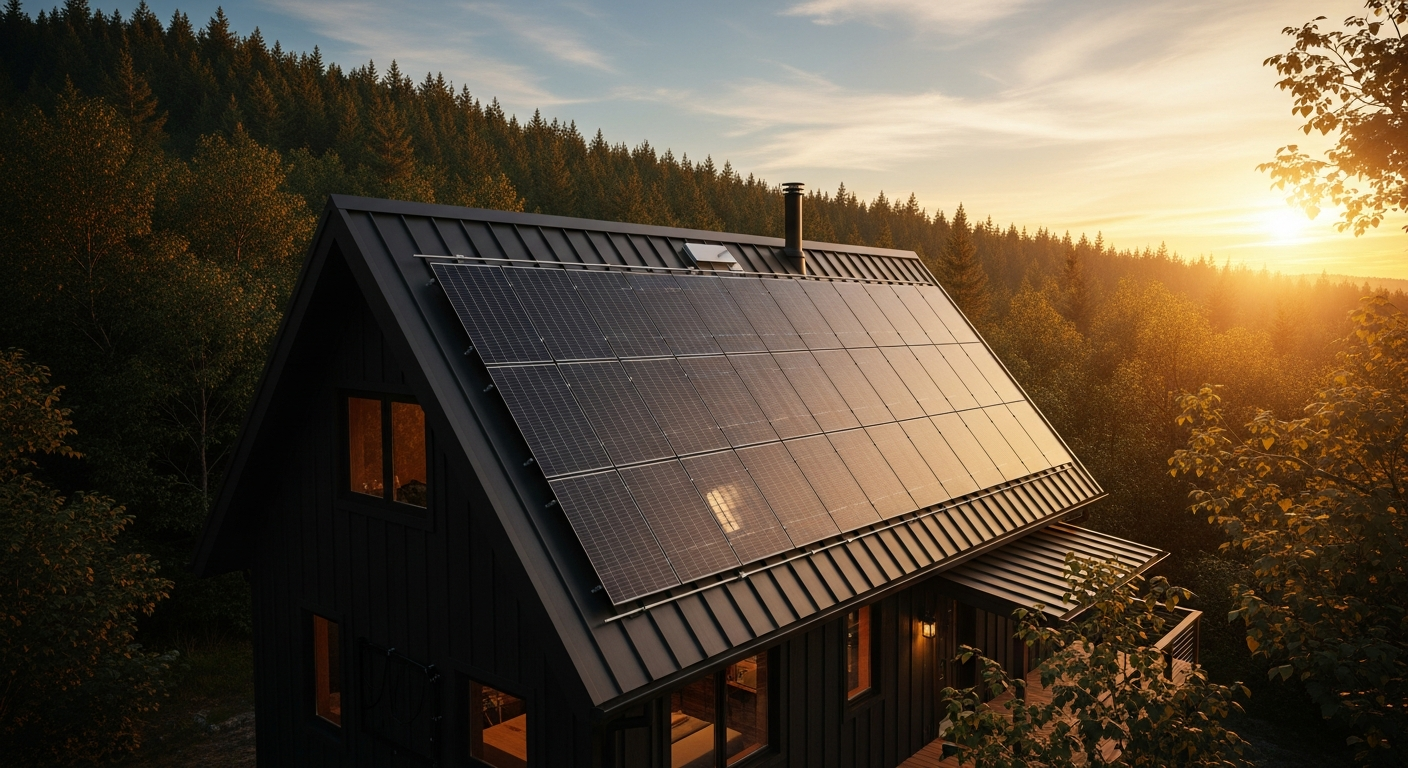
Strategic Overview: The Off-Grid Paradigm in 2026
The year 2026 marks a pivotal inflection point in the distributed energy landscape. The pursuit of off-grid autonomy is no longer a niche endeavor for hobbyists but a strategic imperative for homeowners, remote businesses, and mobile applications seeking resilience against grid instability and volatile energy costs. The market has matured beyond rudimentary setups, now offering highly integrated, efficient, and intelligent systems that rival grid-supplied power in reliability and quality.
Driving this evolution are three core technological vectors. First, the photovoltaic (PV) sector has largely standardized on high-efficiency N-type TOPCon (Tunnel Oxide Passivated Contact) and HJT (Heterojunction) cells, pushing commercially available panel efficiencies comfortably into the 23-25% range. This translates to a greater energy harvest from a smaller physical footprint, a critical factor for space-constrained installations like RVs and tiny homes.
Second, energy storage has been unequivocally conquered by Lithium Iron Phosphate (LiFePO4) chemistry. Its inherent thermal stability, long cycle life (often exceeding 6,000 cycles), and high depth of discharge (DoD) of 90% or more have rendered lead-acid batteries obsolete for any serious off-grid application. In 2026, the focus is on Battery Management System (BMS) intelligence, cell-level monitoring, and seamless integration with the system’s inverter and charge controller.
Finally, power electronics have achieved unprecedented levels of sophistication. Pure sine wave inverters are now the default, ensuring compatibility with sensitive electronics. The proliferation of Gallium Nitride (GaN) technology in smaller, modular kits has increased power density and efficiency. For larger systems, component-based architectures from leaders like Victron Energy offer unparalleled customization and control, managed through sophisticated communication buses like VE.Bus, creating a cohesive energy ecosystem.
Deep Technical Analysis: Engineering Your Energy Independence
Designing a robust off-grid solar system is an exercise in applied physics and meticulous planning. A foundational understanding of the core components and their interplay is non-negotiable for achieving a reliable and long-lasting power solution. This section deconstructs the engineering principles behind a modern off-grid kit.
The Physics of Photovoltaic Energy Conversion
At the heart of every solar panel is the photovoltaic effect. Solar photons, packets of light energy, strike the semiconductor material (typically silicon) of the PV cell. If a photon’s energy exceeds the material’s bandgap, it excites an electron, creating an electron-hole pair. An internal electric field, established by the p-n junction within the cell, separates these pairs, forcing electrons to flow through an external circuit, thus generating direct current (DC).
The efficiency of this conversion is limited by several factors. The Shockley-Queisser limit dictates the maximum theoretical efficiency for a single p-n junction cell, which is around 33.7% for silicon. In 2026, practical efficiencies are governed by mitigating recombination losses (where electrons and holes recombine before being collected), optimizing light absorption, and minimizing resistive losses. Technologies like PERC (Passivated Emitter and Rear Cell) and the now-dominant TOPCon add passivation layers to the cell’s rear surface, reflecting unabsorbed photons back into the silicon and reducing electron recombination, thereby boosting efficiency.
Component Efficiency Benchmarks for 2026 Systems
A system is only as strong as its weakest link. Each component introduces conversion losses that must be accounted for in system sizing. Here are the efficiency benchmarks you should demand in 2026:
- PV Modules (N-type TOPCon/HJT): 23-25% conversion efficiency. Look for a low temperature coefficient, typically below -0.30%/°C, to minimize power loss in high-temperature environments.
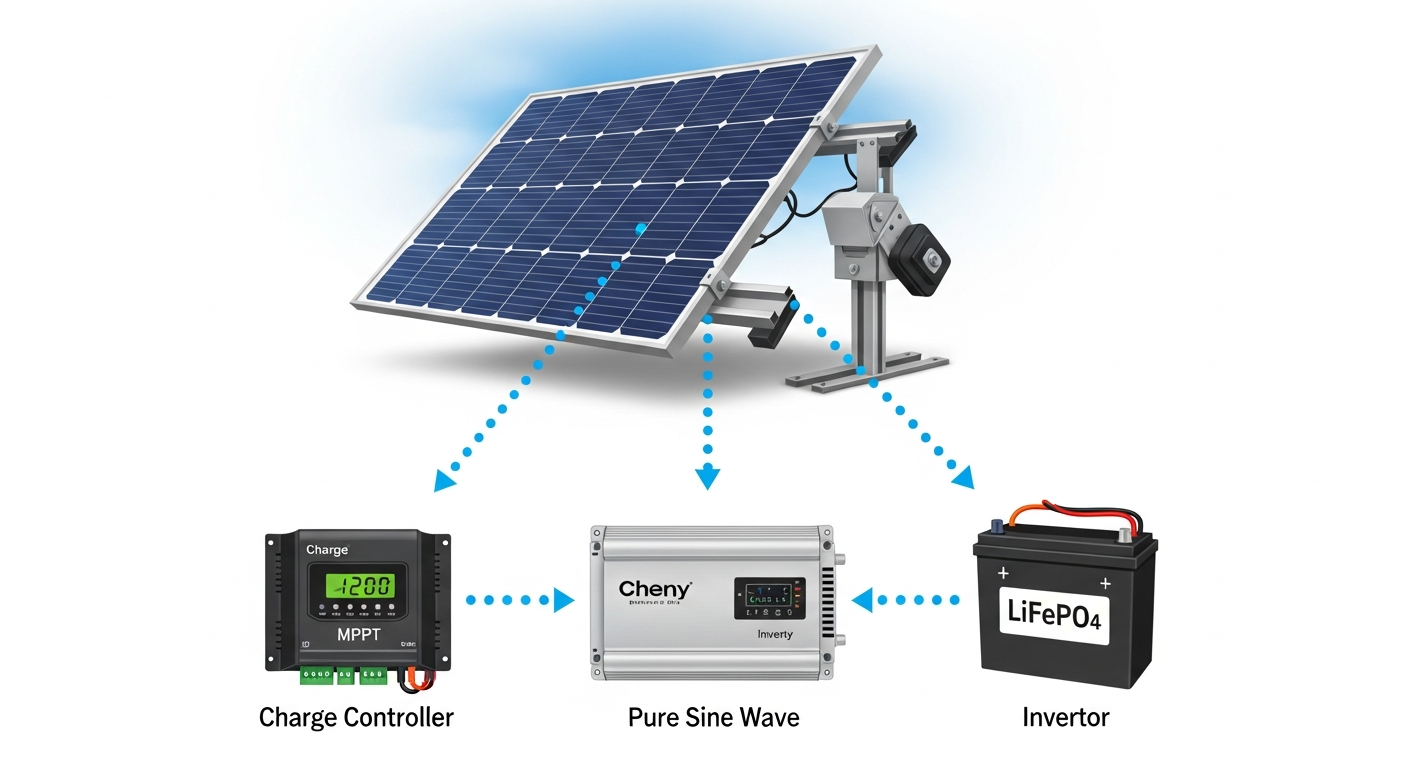
- Charge Controllers (MPPT): A Maximum Power Point Tracking (MPPT) controller is essential. It dynamically adjusts its internal resistance to ensure the solar array operates at its peak power voltage. Expect efficiencies of 99% or higher. Pulse Width Modulation (PWM) controllers are now considered technically obsolete for anything but the smallest, most basic systems.
- Inverters (Pure Sine Wave): The inverter converts DC power from the batteries to AC power for your appliances. Pure sine wave inverters produce a clean, grid-quality waveform, critical for motors, medical equipment, and modern electronics. Look for peak efficiencies of 95-98%. Be aware of idle self-consumption, which can be a significant parasitic drain on the battery.
- Batteries (LiFePO4): The key metric here is round-trip efficiency, which is the energy out divided by the energy in. For LiFePO4, this figure is consistently 92-95%, a stark contrast to the 80-85% of lead-acid batteries.
System Sizing: A Load-Centric Strategy
Proper system sizing is the most critical step. Undersizing leads to power shortages, while oversizing results in unnecessary capital expenditure. Follow this engineering-grade methodology:
1. Conduct a Detailed Energy Audit: Create a list of every AC and DC appliance you intend to run. For each, find its power consumption in Watts (W) and estimate the daily run time in hours. Calculate the daily energy consumption in Watt-hours (Wh) for each appliance (Wh = W * hours). Sum these to find your total daily energy requirement.
2. Size the Battery Bank: Your battery bank must store enough energy to cover your daily needs, plus a reserve for cloudy days (days of autonomy). Use this formula:
Battery Capacity (Ah) = (Total Daily Wh * Days of Autonomy) / (Battery Voltage * Depth of Discharge)
For a LiFePO4 battery with a 90% DoD (0.9) and a 48V system, needing 5000 Wh/day with 2 days of autonomy, the calculation is: (5000 * 2) / (48 * 0.9) = 231.5 Ah. You would select a battery bank of at least 250 Ah at 48V.
3. Size the Inverter: The inverter must handle the maximum simultaneous load. Sum the wattage of all appliances that could run at the same time. This gives you the required continuous output rating. Also, consider the surge rating, which is the inverter’s ability to handle the high inrush current of motors starting up. A 2x surge capacity for 5-10 seconds is a good benchmark.
4. Size the Solar Array: The solar array must be large enough to fully recharge your battery bank while also powering your daytime loads. The key variable is Peak Sun Hours (PSH), which is the average number of hours per day that solar irradiance equals 1000 W/m². This value is location-specific. The formula is:
PV Array Size (W) = Total Daily Wh / (PSH * System Derating Factor)
The derating factor (typically 0.77-0.85) accounts for real-world losses from panel soiling, wiring (voltage drop), inverter inefficiency, and temperature effects. For our 5000 Wh example in a location with 4 PSH and a derating factor of 0.8: 5000 / (4 * 0.8) = 1562.5 W. A 1600W or larger array would be specified.
Engineering Specifications & Innovations in 2026 Kits
The off-grid market is characterized by two primary philosophies: highly integrated, plug-and-play systems and modular, component-based architectures. Both have seen significant innovation.
Brands like EcoFlow and Bluetti have perfected the integrated approach. Their 2026 offerings, like the hypothetical EcoFlow DELTA Pro Max 2, feature modular, stackable LiFePO4 batteries that can scale from 5kWh to 20kWh. The key innovation is the use of GaN-based bi-directional inverters. This allows for extremely fast AC charging (often 0-80% in under an hour) and high-power solar input (up to 3000W) in a compact, portable form factor. Their systems are managed via sophisticated apps, offering real-time monitoring and control over every circuit.
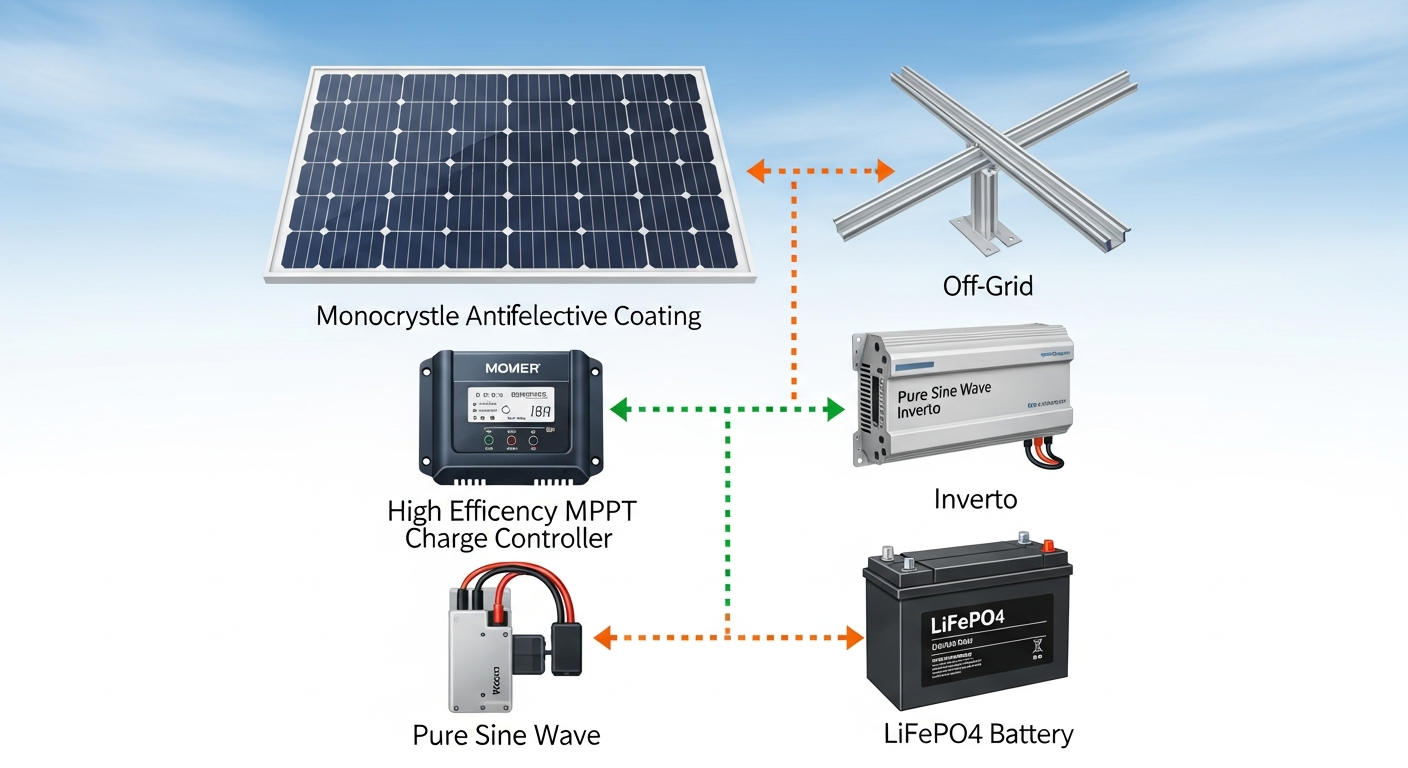
On the other end of the spectrum, Victron Energy continues to dominate the professional and residential off-grid space with its component-based systems. A typical 2026 Victron kit is not a single box, but a symphony of specialized components: MultiPlus-II inverters/chargers, SmartSolar MPPT charge controllers, and Lynx distribution systems, all orchestrated by a Cerbo GX control hub. The power of the Victron ecosystem lies in its VE.Bus and VE.Can communication protocols, which allow for seamless data sharing and coordinated behavior between all devices, enabling advanced functions like power-assist and custom-programmed logic for generator auto-start or load shedding.
A significant materials science development on the horizon is the Perovskite-on-Silicon Tandem Cell. While not yet mainstream in 2026, premium, high-end kits are beginning to feature panels with this technology. By layering a perovskite cell, which captures high-energy blue light, on top of a traditional silicon cell, which captures lower-energy red light, these tandem cells break past the Shockley-Queisser limit for single-junction cells. Early commercial models are demonstrating efficiencies of 28-30%, promising a new era of power density for off-grid arrays.
Technical Comparison Table: Top Off-Grid Solar Kits of 2026
| Kit Model (2026) | Ideal Application | PV Array (Watts & Cell Type) | Battery (Chemistry, kWh, Voltage) | Inverter (Output, Type, Efficiency) | Charge Controller | Key Innovation |
|---|---|---|---|---|---|---|
| EcoFlow DELTA Pro Max 2 | Modular Home Backup, RV, Mobile Work | Up to 3200W (N-type TOPCon) | LiFePO4, 6.0-18.0 kWh (expandable), 48V | 4500W (9000W Surge), Pure Sine, 96% | Integrated Dual MPPT, 150V/30A | GaN-based bi-directional inverter for ultra-fast charging. |
| Victron Freedom 5000 | Off-Grid Cabin, Small Home, Marine | User-defined (typically 2000-4000W, N-type) | LiFePO4, 5.1-20.4 kWh (Victron Smart), 48V | 5000VA MultiPlus-II, Pure Sine, 96% | SmartSolar MPPT 250/100 | VE.Bus ecosystem for total system control and monitoring via Cerbo GX. |
| Bluetti AC600 Titan | Large Home, Commercial Backup | Up to 6000W (N-type TOPCon) | LiFePO4, 10.2-40.8 kWh (expandable), 51.2V | 6000W (12000W Surge), Pure Sine, 97% | Integrated Triple MPPT, 150V/20A each | Split-phase 120V/240V output standard, direct EV charging port. |
| Renogy Pioneer X | DIY Van Life, Skoolie, Small Cabin | 800W (N-type TOPCon, flexible options) | LiFePO4, 4.8 kWh (2x 200Ah), 24V | 3000W, Pure Sine, 94% | Rover MPPT 60A | Cost-effective, component-based kit with excellent DIY support and Bluetooth monitoring. |
| Sol-Ark/Aurea Tandem 8K | High-End Residential, Tech Enthusiast | 3000W (Perovskite-Si Tandem Cells) | LiFePO4, 15 kWh (Aurea Power), 48V | 8000W Limitless-15K, Pure Sine, 96.5% | Integrated Dual MPPT, 500V max | Cutting-edge Perovskite tandem panels for max efficiency; all-in-one inverter. |
Safety & Standards: The Non-Negotiable Engineering Protocols
An off-grid system is a private power plant. As such, it demands rigorous adherence to safety standards to protect both life and property. Ignoring these protocols is not an option. All installations must be designed and executed in compliance with local regulations and the National Electrical Code (NEC).
NEC Compliance and Electrical Safety
The NEC provides a framework for safe electrical design. For solar, Article 690 (Solar Photovoltaic Systems) is paramount. It dictates requirements for wiring, overcurrent protection (fuses and circuit breakers), grounding, and disconnects. For example, rapid shutdown requirements, designed to protect first responders, mandate a way to de-energize PV conductors to safe voltage levels within seconds. This is often achieved with module-level power electronics.
Proper wire sizing, using American Wire Gauge (AWG), is critical to prevent overheating and minimize voltage drop. All DC circuits must be protected by appropriately rated fuses or breakers. A master DC disconnect between the battery bank and inverter is mandatory, as are disconnects for the solar array.
Environmental Protection and Ingress Ratings
Components installed outdoors, such as PV modules, junction boxes, and some inverters, must be rated for environmental exposure. The Ingress Protection (IP) rating system quantifies this. An IP65 rating ensures a component is dust-tight and protected against water jets from any direction, making it suitable for most outdoor locations. For equipment that might face temporary submersion, such as in a flood-prone area or on a marine vessel, an IP67 rating is required.
Battery and Fire Safety Protocols
While LiFePO4 chemistry is significantly more stable and less prone to thermal runaway than other lithium-ion chemistries, it is not without risk. The Battery Management System (BMS) is the first line of defense, preventing over-charge, over-discharge, and over-temperature conditions. However, physical safety measures are still crucial. Batteries should be installed in a well-ventilated, non-combustible enclosure with adequate clearance. It is critical to have a Class ABC or, ideally, a Class D fire extinguisher rated for metal fires nearby. All high-current connections must be torqued to the manufacturer’s specification to prevent arcing.
Operational Checklist: Pre-Installation Engineering Survey
- Site Survey & Solar Resource Assessment: Conduct a thorough analysis of the proposed array location. Use a solar pathfinder or app to identify any shading from trees or structures throughout the day and year. Determine your location’s average Peak Sun Hours (PSH) for accurate array sizing.
- Structural Load Analysis: Confirm that the roof, pole mount, or ground-mount structure can safely support the dead load of the PV array and the additional dynamic loads from wind and snow, as specified by local building codes.
- Permitting and Utility Notification: Check with your local Authority Having Jurisdiction (AHJ) regarding permit requirements for off-grid solar installations. Even if you are not grid-tied, electrical and building permits are often required.
- Component Inventory and Inspection: Upon receipt of your kit, meticulously inventory all parts against the packing list. Inspect each component for shipping damage, paying close attention to PV module glass and battery terminals.
- System Wiring Diagram: Create a detailed, one-line wiring diagram before starting. It should specify all components, wire gauges (AWG), conduit runs, and the location and rating of all overcurrent protection devices (fuses/breakers) and disconnects.
- Tool and Safety Equipment Check: Assemble all necessary tools, including a calibrated torque wrench for electrical connections, a multimeter for voltage and continuity checks, and appropriate Personal Protective Equipment (PPE) such as insulated gloves and safety glasses.
Advanced FAQ: Engineering Insights
How does temperature coefficient affect PV panel output in extreme climates?
The temperature coefficient of power, expressed as %/°C, is a critical parameter. A typical value of -0.30%/°C means that for every degree Celsius the cell temperature rises above the standard test condition of 25°C, the panel’s maximum power output decreases by 0.30%. In a hot desert climate where cell temperatures can reach 75°C (a 50°C rise), this results in a 15% power loss (50°C * -0.30%/°C). Conversely, in very cold, sunny conditions, the panel’s voltage can rise significantly, a factor that must be considered when sizing the MPPT charge controller to avoid exceeding its maximum input voltage limit.
What are the pros and cons of a 24V vs. 48V system architecture?
For any system over 1500W, a 48V architecture is superior. According to Ohm’s Law (P=V*I), for a given power (P), doubling the voltage (V) halves the current (I). Lower current allows for the use of smaller, less expensive copper wiring (a higher AWG number) and significantly reduces resistive power losses (I²R losses) in the system, increasing overall efficiency. A 24V system may be adequate for smaller RV or van systems, but 48V is the professional standard for residential off-grid systems due to its higher efficiency and safety margin.
Can I integrate a wind turbine with my solar kit, and what’s required?
Yes, creating a solar-wind hybrid system is an excellent way to improve energy reliability, as wind and solar resources are often complementary. To integrate a wind turbine, you need a dedicated charge controller designed for wind, often called a diversion or dump load controller. This controller manages the turbine’s output and protects the battery from overcharging by diverting excess energy to a resistive load (like a water heater element or resistor bank) when the battery is full. Some advanced hybrid inverters or system controllers offer dedicated inputs for wind, simplifying integration.
Explain the difference between MPPT and PWM charge controllers and why MPPT is standard in 2026.
A Pulse Width Modulation (PWM) controller is a simple switch that connects the solar array to the battery. It forces the array to operate at the battery’s voltage, which is rarely the array’s optimal Maximum Power Point (MPP) voltage. This mismatch results in a significant power loss, often 20-30%. An MPPT controller is a sophisticated DC-DC converter. It allows the array to operate at its MPP voltage (e.g., 36V) while efficiently converting the power down to the battery’s voltage (e.g., 24V or 48V), capturing the full power of the array. The efficiency gains, especially in cold weather, make MPPT the only logical choice for any serious off-grid system in 2026.
What is “voltage drop” and how do I calculate and mitigate it in long wire runs?
Voltage drop is the loss of electrical potential along the length of a conductor due to its internal resistance. It’s a critical consideration, especially in the long wire run from the solar array to the charge controller. Excessive voltage drop (ideally kept below 2-3%) wastes power and can cause equipment to malfunction. You can calculate it using the formula: Voltage Drop = (2 * Length * Current * Resistance per foot) / 1000. To mitigate it, you can increase the wire’s cross-sectional area (use a thicker wire, i.e., a lower AWG number), increase the system voltage (e.g., use a 48V system instead of 12V), or shorten the wire run.
📥 Associated Resource:

El Kouriani Abde Civil Engineer & Founder of SolarKiit
El Kouriani Abde is a seasoned Civil Engineer and Project Manager with over 21 years of field experience. As the founder and publisher of SolarKiit.com, he leverages his deep technical background to simplify complex renewable energy concepts. His mission is to provide homeowners and professionals with accurate, engineering-grade guides to maximize their solar investments and achieve energy independence.