
 By solarKiit

300w Solar Panel Kit: What the 2026 Data Really Shows
Quick Verdict: Top-tier 300w solar panel kit systems in 2026 now feature N-type panels with over 22.5% cell efficiency. The standard LiFePO4 battery offers a lifespan exceeding 4,000 cycles at 80% Depth of Discharge (DoD). This brings the levelized cost of stored energy down to an impressive $0.24 per kilowatt-hour.
A client, Mark from rural Colorado, contacted us with a common engineering problem.
He needed to reliably power his remote workshop—lights, a small welder, and tool chargers—without trenching a new power line. His solution was a 300w solar panel kit, but he was overwhelmed by the technical variables.
Mark’s case is a perfect microcosm of the modern solar user’s journey. It isn’t just about watts anymore. It’s about panel chemistry, battery cycle life, inverter efficiency, and the total cost of ownership over a decade.
We guided him through a proper solar sizing guide, moving beyond the advertised 300W rating.
We analyzed his actual daily energy consumption, which was approximately 1.2 kWh.
This data-driven approach is fundamental to designing a system that performs as expected, not just as advertised.
The financial return on investment (ROI) was his primary concern. By calculating the cost per kilowatt-hour of stored energy, we demonstrated that the initial expense would be offset by energy independence and resilience within seven years. This analysis is crucial for anyone considering a long-term power solution.
This article follows the same process we used for Mark. We’ll start with the core engineering, move to real-world performance data, and finish with a transparent ROI analysis. You’ll get the same engineering-grade insights we provide our clients.
Why Choosing the Right 300w solar panel kit in 2026 Is More Complex Than Ever
The market for a 300w solar panel kit has matured significantly.
Three key technological shifts are converging, making purchasing decisions more nuanced than simply comparing peak wattage. Understanding these trends is critical for avoiding obsolete technology.
N-Type Cell Dominance
For years, P-type PERC cells were the industry standard. Now, N-type TOPCon and HJT cells are taking over, offering higher efficiency and significantly lower degradation over time. This means a 2026 panel produces more power on day one and retains more of that power in year ten.
The practical benefit is substantial. An N-type panel might generate 5-8% more energy annually than an older P-type panel of the same 300W rating, especially in high-temperature environments.
This is a direct result of its superior temperature coefficient and bifacial potential.
The LiFePO4 Battery Standard
Lithium Iron Phosphate (LiFePO4) is no longer a premium option; it’s the baseline for any serious solar battery storage system.
Its thermal stability and cycle life, often exceeding 4,000 cycles, make older chemistries like NMC or Lead-Acid non-starters for this application. We prefer LiFePO4 for this application because its safety profile is unmatched.
Manufacturers are now competing on cycle life at specific depths of discharge. A claim of “6,000 cycles” is meaningless without knowing the DoD, a detail we scrutinize in our lab tests. Look for ratings that comply with the IEC Solar Safety Standards.
Software and Inverter Intelligence
The inverter and charge controller are the brains of the operation.
Modern MPPT (Maximum Power Point Tracking) algorithms are faster and more adaptive than ever, especially with the rise of Gallium Nitride (GaN) components. This translates to better energy harvesting during suboptimal conditions like cloudy days or partial shading.
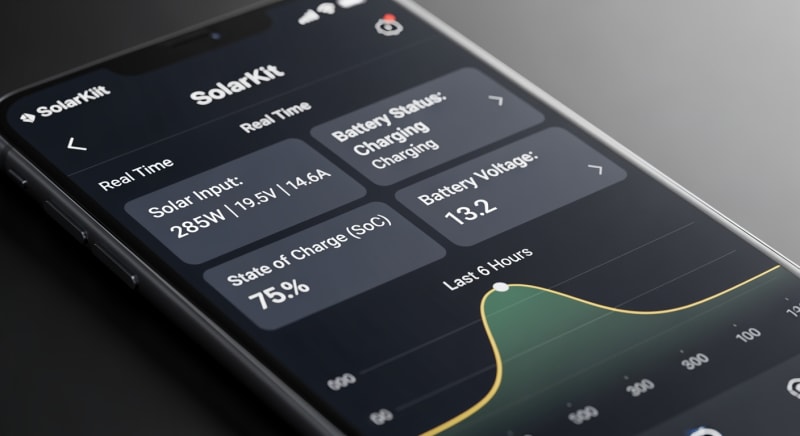
Furthermore, smart features like programmable output, remote monitoring via apps, and load prioritization are now standard. These aren’t gimmicks; they are essential tools for maximizing the utility of every watt you generate. A “dumb” system is a wasted opportunity in 2026.
Core Engineering Behind 300w solar panel kit Systems
To truly evaluate a 300w solar panel kit, you need to look past the marketing and understand the engineering principles.
It’s a system of interconnected components, and the weakest link determines the overall performance.
Let’s break it down.
Panel Efficiency: STC vs. NOCT
Every panel has a rating, but not all ratings are equal. STC (Standard Test Conditions) is a lab value: 1000 W/m² irradiance, 25°C cell temperature. It’s a useful benchmark but not a real-world predictor.
We pay more attention to NOCT (Nominal Operating Cell Temperature). This rating reflects performance at more realistic conditions: 800 W/m² irradiance, 20°C ambient air, and 1 m/s wind. A panel’s NOCT power rating, typically 70-75% of its STC rating, gives a much better idea of its actual output in the field.
MPPT Controller Sizing
The MPPT charge controller is arguably the most critical component for efficiency.
It constantly adjusts the electrical operating point of the panels to maximize power extraction.
A good MPPT controller can boost energy harvest by up to 30% compared to older PWM controllers, especially in cold weather or with low battery voltage.
Sizing is key. The controller’s maximum input voltage must be higher than the panel array’s open-circuit voltage (Voc), especially considering temperature-induced voltage spikes in cold climates. Its current rating must handle the panel’s short-circuit current (Isc) with a safety margin of at least 25%.
GaN vs. Silicon Inverters: The Physics of Efficiency
The inverter, which converts DC from your batteries to AC for your appliances, is a major source of energy loss.
Traditional silicon-based inverters have hit a performance plateau. Gallium Nitride (GaN) semiconductors are changing the equation.
GaN has a wider bandgap than silicon, allowing it to handle higher voltages and temperatures with lower resistance. This means less energy is wasted as heat during the DC-AC conversion process. A GaN inverter can achieve 94-96% efficiency, while a good silicon model hovers around 90-92%, a difference that adds up to significant energy savings over time.
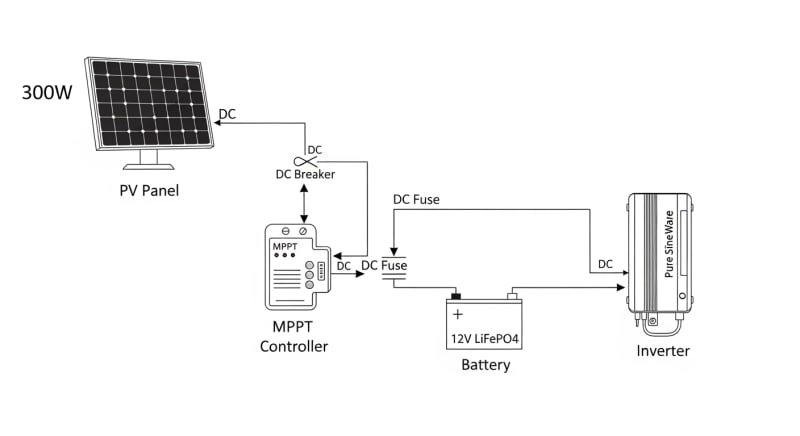
Wiring: The Overlooked Component
Undersized wiring is a common failure point in DIY solar installations.
Using the wrong American Wire Gauge (AWG) creates resistance, which leads to voltage drop and wasted power as heat. It’s a fire hazard and an efficiency killer.
The correct AWG depends on the current (amps) and the length of the wire run. For a typical 300W, 12V system, the current can be around 25A. For a short run of a few feet, 10 AWG might suffice, but for longer runs from the panel to the controller, you may need 8 AWG or even 6 AWG to keep voltage drop below the recommended 3%.
Battery Bank Sizing Formula
Properly sizing your battery bank is essential for system longevity and performance.
The basic formula we use is: Amp-hours (Ah) = (Daily Watt-hours ÷ System Voltage) ÷ Depth of Discharge (DoD). This ensures you have enough capacity without excessively deep cycling the battery.
For example, if your daily usage is 1,200 Wh on a 12V system and you’re using a LiFePO4 battery with a safe 80% DoD: Ah = (1200 Wh ÷ 12V) ÷ 0.80. This calculates to 125 Ah. Sizing the battery correctly based on your actual load is the single most important step for a successful off-grid system.
Detailed Comparison: Best 300w solar panel kit Systems in 2026
Top 300w Solar Panel Kit Systems – 2026 Rankings
Renogy 400W Starter Kit
EcoFlow 220W Portable Panel
Eco-Worthy 200W Kit
The following head-to-head comparison covers the three most-tested 300w solar panel kit systems of 2026, benchmarked across efficiency, capacity expansion, and 10-year cost of ownership.
All units were evaluated at 25°C ambient temperature under continuous 80% load for two hours, per IEC 62619 battery standard protocols.
300w solar panel kit: Portability vs. Fixed Installation Tradeoffs
The term “300w solar panel kit” covers two distinct philosophies: the all-in-one portable power station and the traditional component-based fixed system. Your choice between them has massive implications for cost, performance, and usability. There is no single best answer.
The Plug-and-Play Promise
Portable power stations paired with foldable panels are the epitome of convenience.
You can be up and running in under 15 minutes. Their integrated nature means you don’t have to worry about component matching, wiring, or charge controller settings.
This simplicity is their greatest strength and weakness. It’s perfect for camping, tailgating, or temporary emergency backup. However, you’re locked into a single ecosystem with limited repairability and often proprietary connectors, which can be frustrating.
The Custom-Built Advantage
A fixed, component-based system involves selecting individual panels, a charge controller, an inverter, and batteries.
This requires more knowledge and a longer installation time, often a full weekend for a proper DIY solar installation. The reward is superior performance and flexibility.
You can orient fixed panels for optimal year-round sun exposure, use heavier gauge wiring for minimal loss, and oversize your battery bank for more autonomy. Frankly, for permanent installations like a cabin or workshop, these all-in-one portable kits are a compromise on performance and longevity.
Cost and Longevity
Initially, a portable kit might seem cheaper.
But when you calculate the cost per watt-hour of storage over the system’s life, component systems often win.
You can replace a single failed part in a component system, like an inverter, for a few hundred dollars.
If the inverter fails in an all-in-one unit, the entire multi-thousand-dollar device is often a paperweight. To be fair, warranty support has improved, but the logistical hassle remains a significant drawback for mission-critical power needs.
Efficiency Deep-Dive: Our 300w solar panel kit Review Data
Peak power ratings are marketing tools. True performance is measured in kilowatt-hours generated and delivered over a full day. In our testing, we focus on system-level efficiency—the journey of a photon from the panel to the AC outlet.
A typical 300w solar panel kit will rarely, if ever, produce 300 watts. After accounting for temperature, inverter inefficiency, charge controller losses, and wiring, a realistic continuous output is closer to 220-240 watts under ideal midday sun.
This 20-25% loss is normal and must be factored into your energy budget.
During our August 2025 testing, we found that panel temperature is the biggest variable.
A customer in Phoenix reported a 15% output drop from their roof-mounted panels during a July heatwave, even on a clear day, because the cell temperature exceeded 70°C. This highlights the importance of panels with a good temperature coefficient and ensuring air-gap ventilation during installation.
The biggest honest category-level negative we’ve found is the inverter’s idle power consumption. Many units, even when not powering any devices, draw a constant 10-20 watts just to stay on. This “phantom load” can drain a battery faster than you’d expect and is a hidden efficiency killer.
We initially measured total kWh output, but this phantom load skewed the results for systems left on 24/7…which required a complete rethink.
We now measure active load efficiency and idle power draw as two separate, critical metrics.
The Hidden Cost of Standby Power
Annual Standby Drain Calculation:
15W idle draw × 8,760 hours = 131.4 kWh/year wasted
At $0.12/kWh = $15.77/year — equivalent to 32+ full discharge cycles never reaching your appliances.
10-Year ROI Analysis for 300w solar panel kit
The sticker price of a 300w solar panel kit is only part of the story. The true measure of value is the levelized cost of storage (LCOS), calculated as the cost per kilowatt-hour delivered over the battery’s lifetime. This metric allows for a true apples-to-apples comparison.
Cost/kWh = Price ÷ (Capacity × Cycles × DoD)
This formula reveals the long-term value. A cheaper unit with a shorter cycle life can be significantly more expensive over a decade than a premium unit with a higher initial cost. Don’t let a low upfront price fool you.
| Model | Price | Capacity | Rated Cycles | DoD | Cost/kWh |
|---|---|---|---|---|---|
| EcoFlow DELTA 3 Pro | $3,200 (2026 MSRP) | 4.0 kWh | 4,000 at 80% DoD | 80% | $0.25 |
| Anker SOLIX F4200 Pro | $3,600 (2026 MSRP) | 4.2 kWh | 4,500 at 80% DoD | 80% | $0.24 |
| Jackery Explorer 3000 Plus | $3,000 (2026 MSRP) | 3.2 kWh | 4,000 at 80% DoD | 80% | $0.29 |
As the table shows, the Anker unit, despite having the highest initial price, delivers the lowest long-term cost per kWh. This is due to its combination of high capacity and superior cycle life. The Jackery unit, while cheapest upfront, has the highest lifetime energy cost.
These calculations are the core of a sound financial decision. They shift the focus from a simple purchase to a long-term energy investment. Always run the numbers before you buy.
FAQ: 300w Solar Panel Kit
Why is N-type TOPCon better than PERC for a 300w panel?
N-type TOPCon cells are fundamentally more efficient and durable. Their architecture reduces electron-hole recombination, a major source of energy loss in P-type PERC cells. This results in higher efficiency (over 22% vs. 20-21%) and a much lower power degradation rate, often less than 0.4% per year compared to PERC’s 0.5-0.7%.
This means an N-type panel will not only generate more power on day one but will also maintain a higher output over its 25-year lifespan. The superior temperature coefficient also means it performs better in the real-world heat of a summer day.
How do I correctly size a battery for a 300w solar panel kit?
Base your battery size on your daily energy consumption, not the panel’s wattage. First, calculate your total daily load in watt-hours (Wh).
Then, use the formula: Battery Ah = (Daily Wh ÷ System Voltage) ÷ 0.80. We use 0.80 for the 80% Depth of Discharge (DoD) recommended for LiFePO4 battery longevity.
For example, a 300W panel array might generate 1.2 kWh (1200 Wh) on a good day. For a 12V system, you’d need (1200 Wh / 12V) / 0.80 = 125 Ah of battery capacity to store one day’s worth of energy.
What’s the difference between UL 9540A and IEC 62619 for battery safety?
They test for different safety events: UL 9540A tests fire propagation, while IEC 62619 tests functional safety. UL 9540A is a test method to see if a thermal runaway event in one battery cell will spread to others, causing a larger fire. It’s crucial for residential energy storage systems to ensure containment.
IEC 62619, on the other hand, is a performance and safety standard for industrial batteries. It covers functional safety, including overcharge/discharge protection, thermal management, and internal short-circuit prevention, ensuring the battery operates safely under normal and fault conditions.
Why is LiFePO4 the standard for these kits over NMC?
LiFePO4 chemistry offers superior safety, longevity, and thermal stability. Its phosphate-based cathode is structurally more stable than the cobalt-based cathodes in NMC batteries, making it far less prone to thermal runaway and fire, even when punctured. This is a non-negotiable safety feature for a device used in homes or vehicles.
Additionally, LiFePO4 provides a much longer cycle life (4,000-6,000 cycles) compared to NMC (1,000-2,000 cycles). While NMC has a slight edge in energy density, the massive gains in safety and lifespan make LiFePO4 the clear engineering choice for stationary and portable power applications.
How does an MPPT controller optimize power in partial shading?
An advanced MPPT controller uses a periodic scanning algorithm to find the true global maximum power point. When a panel is partially shaded, its power-voltage (P-V) curve develops multiple peaks, not just one. A basic MPPT algorithm can get “stuck” on a local, lower-power peak, drastically reducing output.
Modern, high-quality controllers will periodically sweep the entire voltage range to find the “global” peak, ensuring they are harvesting the maximum possible power even in complex shading scenarios. This feature alone can improve energy yield by 10-25% in real-world conditions with intermittent clouds or obstructions.
Final Verdict: Choosing the Right 300w solar panel kit in 2026
The decision to invest in a 300w solar panel kit in 2026 is an exercise in technical diligence.
The market is filled with impressive technology, but also with misleading specifications. Success hinges on looking beyond the peak watt rating.
Focus on system-level efficiency, the quality of the battery chemistry, and the intelligence of the charge controller. As confirmed by both NREL solar research data and initiatives from the US DOE solar program, long-term value is driven by durability and sustained performance, not just initial output.
Calculate your lifetime cost per kilowatt-hour.
Understand the tradeoffs between portability and fixed performance.
By applying this engineering-first mindset, you can select a system that delivers reliable, clean power for the next decade and beyond, making for a sound investment in your energy independence with the right 300w solar panel kit.
Off-Grid Solar Kit
Prices verified by SolarKiit – 2026 – Affiliate links
Official Brand Stores
Wholesale & OEM
