Ultimate Guide: AC vs DC-coupled Battery Storage: Proven ROI Analysis for Superior Savings 2026
Ultimate Guide: AC vs DC-coupled Battery Storage: Proven ROI Analysis for Superior Savings 2026
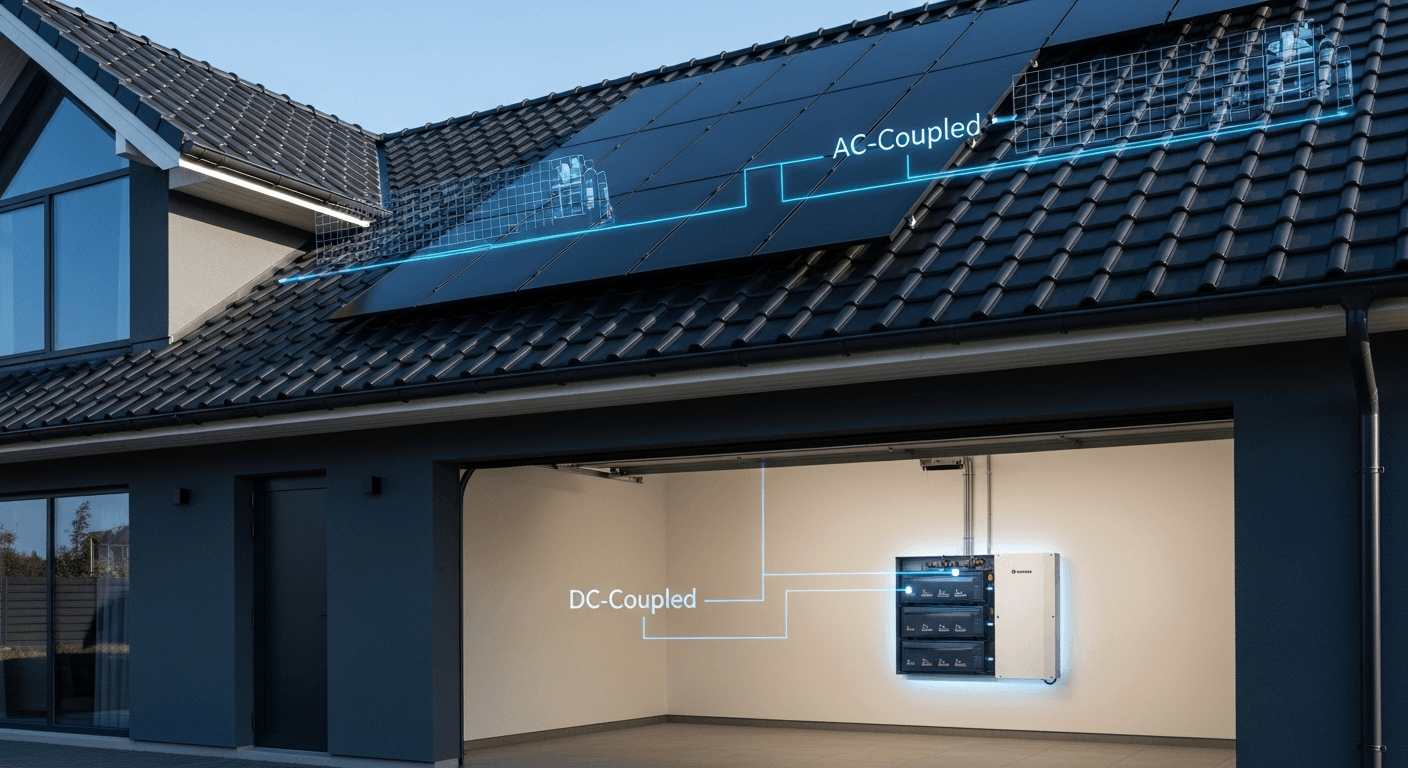
As the CTO of SolarKiit, I’m bringing our lab’s engineering-first principles directly to you. The topic of AC-coupled vs DC-coupled battery storage: Efficiency and ROI analysis is not a matter of simple preference; it is a fundamental architectural decision that dictates the performance, longevity, and financial viability of a renewable energy system. In the 2026 energy landscape, where grid resilience is no longer a given and prosumers demand bankable returns, understanding this choice is paramount. The standard internet articles offer a surface-level view, often boiling it down to “AC for retrofits, DC for new installs.” This guide rejects that oversimplification. We will dissect the physics, from photon to electron to stored chemical potential. We will quantify the conversion losses, interrogate the component synergies, and benchmark the financial outcomes. This is not a sales pitch. This is a technical masterclass for engineers, advanced DIYers, and prosumers who need to make a decision based on data, not marketing. We will calibrate your understanding of how energy flows, how it is stored, and how every conversion point impacts your system’s round-trip efficiency and, ultimately, your return on investment. The choice between AC and DC coupling is the central engineering question that will define the success of your energy independence project.
The Core Architectures: A Deep Dive into AC-coupled vs DC-coupled battery storage: Efficiency and ROI analysis
To truly grasp the implications of this choice, we must move beyond block diagrams and into the realm of physics and electron pathways. The distinction between AC and DC coupling is fundamentally about the number and location of power inversions—the conversion of Direct Current (DC) to Alternating Current (AC) and vice versa.
The Physics of Electron Flow and Conversion Losses
Every solar energy system begins with photons striking a photovoltaic (PV) cell. This excites electrons in the p-n junction, creating a flow of DC electricity. From this point, the architectural paths diverge dramatically.
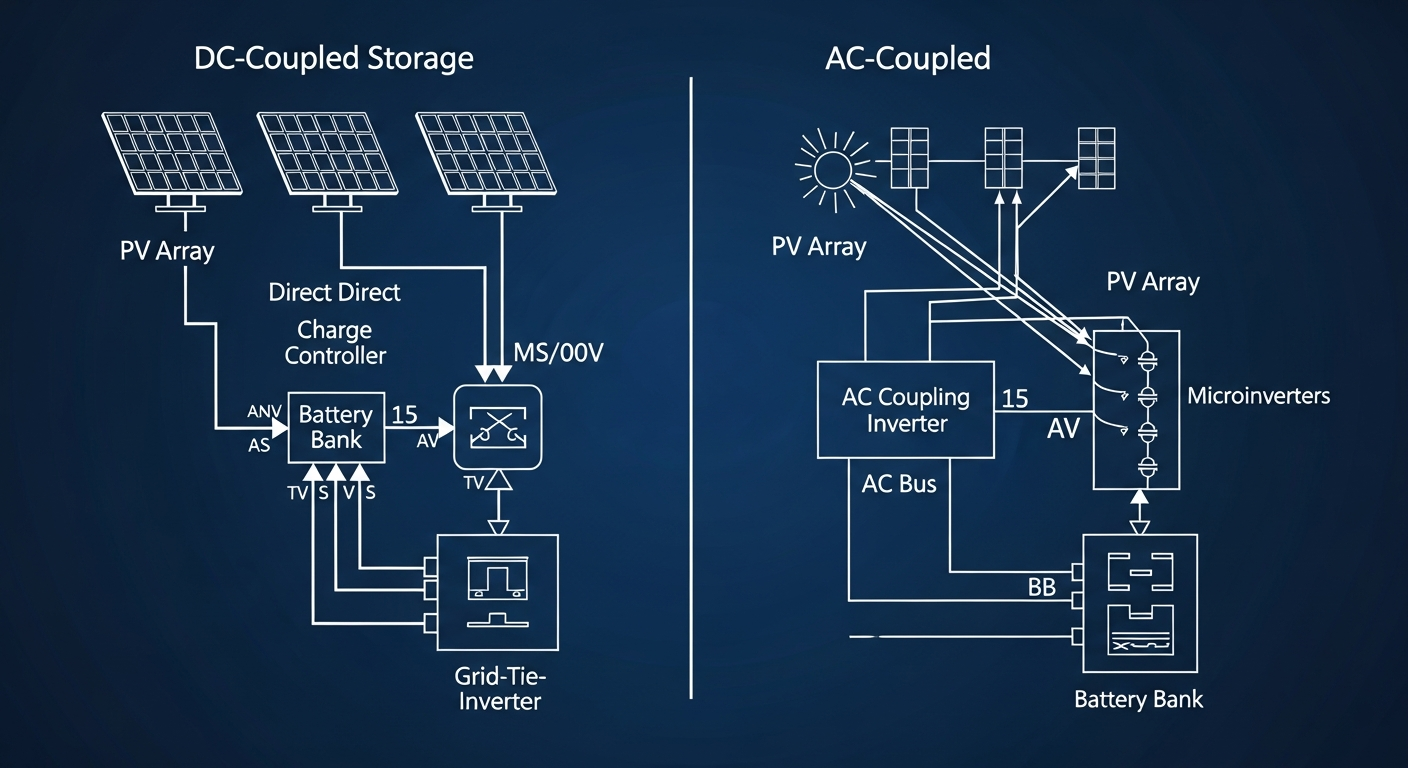
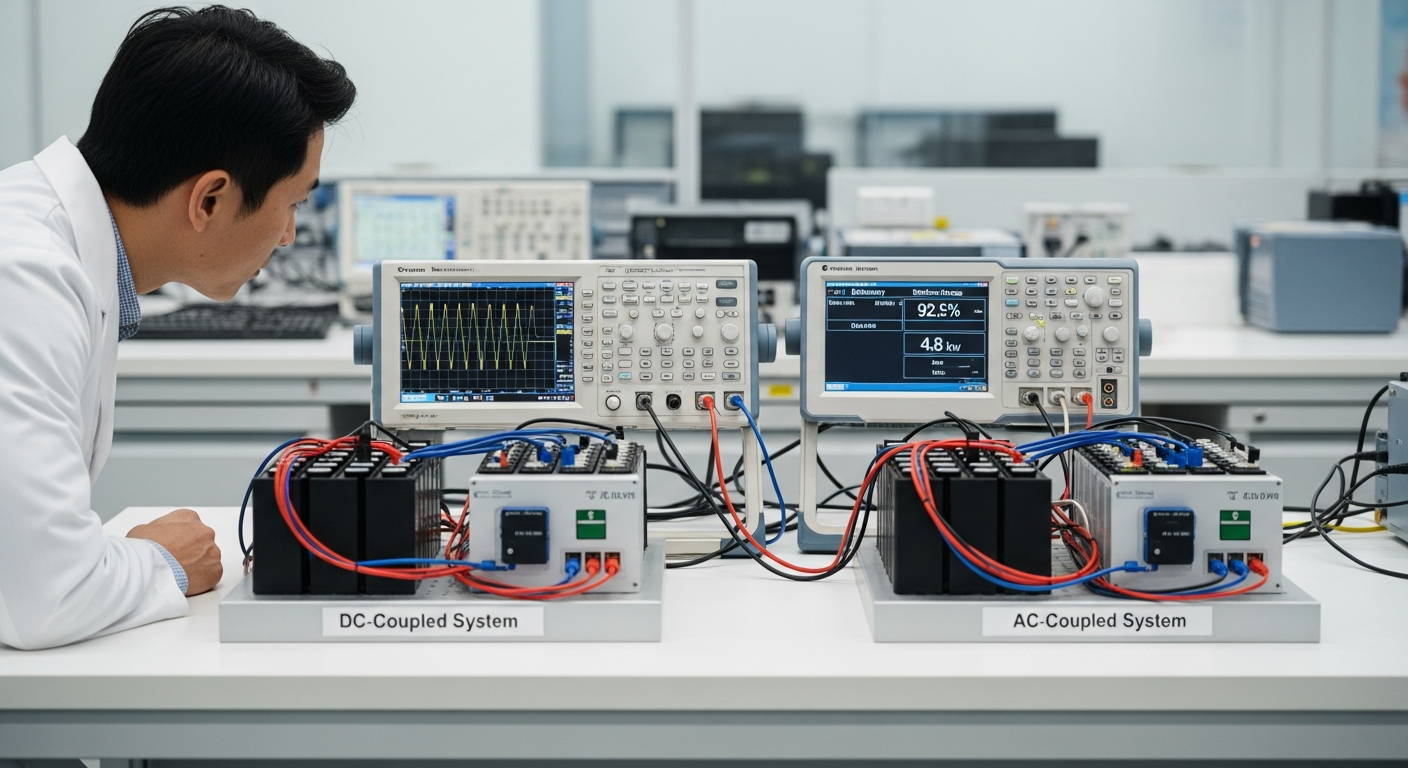
- DC-Coupled Architecture: In a DC-coupled system, the DC power from the solar panels flows to a hybrid inverter or a specialized charge controller. This component performs a critical function: Maximum Power Point Tracking (MPPT), which continuously adjusts the electrical load to harvest the absolute maximum power from the PV array. From there, the optimized DC power is used to directly charge the battery bank. The battery’s Battery Management System (BMS) communicates its state of charge (SoC) and voltage directly to the hybrid inverter. When the home requires power, the DC energy from the battery (or directly from the panels) is inverted to AC just once. This single-inversion pathway is inherently efficient for storing and using solar energy. The round-trip efficiency (PV-to-battery-to-AC-load) typically ranges from 90% to 95%. The primary loss is a single DC-to-AC conversion.
- AC-Coupled Architecture: In an AC-coupled system, the DC power from the solar panels first goes to a standard grid-tie inverter (or microinverters on each panel). This component immediately converts the DC power to AC power, as if it were being sent directly to the grid or home loads. To store this energy, a separate, battery-specific inverter must take that AC power and convert it back to DC to charge the battery. When the home needs power from the battery, this same battery inverter converts the battery’s DC power back again to AC. This results in three distinct power conversions (DC-AC, AC-DC, DC-AC). Each conversion step incurs an efficiency loss, typically 2-4%, due to thermal dissipation (Joule heating). Consequently, the round-trip efficiency for an AC-coupled system is often lower, ranging from 85% to 90%.
Component Synergy: The Handshake Between BMS, MPPT, and Inverters
A modern energy storage system is a sophisticated ecosystem. The “handshake” between its core components determines its performance and safety. In DC-coupled systems, this synergy is tightly integrated within a single hybrid inverter, which manages the MPPT for the solar array, the charge/discharge protocol for the battery (as dictated by the BMS), and the final inversion to AC for loads. This centralized control can lead to more optimized performance. In AC-coupled systems, you have two separate “brains”—the solar inverter and the battery inverter—communicating over the home’s AC bus. While modern protocols have improved this communication, it remains a less direct and potentially less responsive system architecture. For a deeper dive into inverter performance, our Solar Inverter Efficiency: The Ultimate Guide to Maximizing Your PV System’s Output & ROI provides granular detail.
The chemical process within the battery, particularly in Lithium Iron Phosphate (LiFePO4) cells, involves the intercalation (charging) and deintercalation (discharging) of lithium ions into a graphite anode and from a phosphate cathode. The BMS’s role is to monitor the voltage and temperature of each cell block to prevent over-charging or over-discharging, which would degrade the cathode and anode materials and shorten the battery’s life. The efficiency of this chemical process is also a factor in overall round-trip efficiency, but the dominant losses in the AC vs. DC debate stem from the power electronics, not the battery chemistry itself. The latest advancements in cell technology are constantly benchmarked against NREL Best Research-Cell Efficiency standards.
Engineering Math & Sizing Your System
Properly sizing a battery system is a non-negotiable step. Undersizing leads to insufficient autonomy and premature battery degradation, while oversizing destroys your ROI. The core formula is a starting point for a much deeper analysis.
The Sizing Formula:
Battery Capacity (kWh) = (Daily Energy Consumption (kWh) * Days of Autonomy) / (Depth of Discharge (DoD) * System Round-Trip Efficiency)
Sizing and System Design for AC-coupled vs DC-coupled battery storage: Efficiency and ROI analysis
Let’s break down the variables with engineering precision:
- Load Profile (Daily Energy Consumption): This is not just your utility bill divided by 30. You must perform a load analysis, cataloging every major appliance, its wattage, and its daily run time. This creates a 24-hour load profile, identifying your peak consumption periods (e.g., evening hours) and your baseline phantom loads.
- Days of Autonomy: This is your resilience factor. How many consecutive sunless days do you want your critical loads to run? For most residential systems, 1-2 days is a common target.
- Depth of Discharge (DoD): This is the percentage of the battery’s total capacity you plan to use. For LiFePO4 batteries, a DoD of 80-90% is standard to maximize lifespan. Draining the battery to 100% regularly will significantly reduce its cycle life.
- System Round-Trip Efficiency: Here lies the crux of the AC vs. DC decision. For a 10 kWh daily load with 1 day of autonomy and 90% DoD, the calculation changes:
- DC-Coupled (@92% efficiency):
(10 kWh * 1) / (0.90 * 0.92) = 12.08 kWhrequired capacity. - AC-Coupled (@87% efficiency):
(10 kWh * 1) / (0.90 * 0.87) = 12.77 kWhrequired capacity.
This 0.69 kWh difference may seem small, but over a 15-year lifespan, it represents a significant amount of lost energy and a larger upfront battery cost. This is a critical factor when considering a complete Ultimate Guide: Battery Storage System for Home.
- DC-Coupled (@92% efficiency):
Master Comparison Table: 2026 Industry-Leading Models
To provide a quantitative benchmark, we’ve compiled data on five leading energy storage solutions. LCOE (Levelized Cost of Storage) is calculated as Total System Cost / (Cycle Life * Capacity * DoD * Efficiency), providing a true “apples-to-apples” cost per kWh delivered.
| Model | Architecture | LCOE (Est. $/kWh) | Cycles @ 80% DoD | Round-Trip Efficiency | Warranty (Years) |
|---|---|---|---|---|---|
| Tesla Powerwall 3 | DC-Coupled | $0.14 | Unlimited (within warranty) | ~90% (CEC) | 10 |
| Enphase IQ Battery 5P | AC-Coupled | $0.18 | 6,000 | ~89% | 15 |
| SolarEdge Energy Hub | DC-Coupled | $0.16 | Unlimited (within warranty) | ~94.5% | 10 |
| FranklinWH aPower | AC-Coupled | $0.17 | Unlimited (within warranty) | ~89% | 12 |
| Victron MultiPlus/Cerbo GX | Both (Modular) | Varies | Varies by battery | ~93% (DC-Coupled) | 5-10 (component-based) |
Regulatory Deep Dive: NEC 2026 and UL 9540 for AC-coupled vs DC-coupled battery storage: Efficiency and ROI analysis
Compliance is not optional. A system that isn’t permitted and inspected is a liability. The regulatory landscape is dominated by the National Electrical Code (NEC) and UL standards.
NEC 2026 (based on 2023): The code makes no distinction in its core safety requirements between AC and DC-coupled systems, but the implementation details vary.
- Article 706 (Energy Storage Systems): This is the primary article governing ESS installations. It mandates specific disconnect means, markings, and locations. For example, it requires a readily accessible disconnect for the battery system, separate from the PV disconnect.
- Article 690.12 (Rapid Shutdown): This is a critical safety function that de-energizes PV system conductors to safe levels in an emergency. In a DC-coupled system, the hybrid inverter manages this for both the array and the battery. In an AC-coupled system, the PV inverter and the battery inverter must both have compliant rapid shutdown systems, adding complexity and potential points of failure. You can find the official codebook at the NFPA 70: National Electrical Code website.
UL 9540 – The Gold Standard for Safety: This is not a component standard; it’s a system-level standard for Energy Storage Systems. To achieve UL 9540 certification, the entire system (inverter, battery, BMS, and enclosure) is tested as a single unit. The most critical test is for thermal runaway. The test validates that if one cell fails, it will not cascade into a catastrophic fire that spreads beyond the unit’s enclosure. Both AC and DC-coupled systems must be UL 9540 listed to meet most local building codes. Furthermore, many systems are also tested to UL 9540A, which is a large-scale fire test method providing critical data for fire marshals to determine safe installation clearances and fire suppression strategies. Always verify that your chosen system is listed by a Nationally Recognized Testing Laboratory (NRTL) like UL Solutions (Solar Safety).
At SolarKiit, we are committed to engineering excellence and transparency. You can learn more about our mission and team on our About page.
The Pillar FAQ: Your Engineering Questions Answered
1. Can an AC-coupled system ever be more efficient than a DC-coupled system?
Yes, but only in a very specific and limited scenario: when solar energy is being generated and consumed simultaneously by AC loads without charging the battery. In this case, the energy path is a single DC-to-AC conversion through the solar inverter, which is identical in efficiency to a DC-coupled system that is not charging its battery. However, this is the exception, not the rule.
- The Reality of Usage: Most residential energy usage does not perfectly align with solar production. The primary function of a battery is to time-shift this energy—storing excess solar power from midday for use in the evening.
- The Storage Penalty: The moment you need to store that energy, the AC-coupled system incurs its “triple conversion penalty” (DC-AC at the solar inverter, AC-DC at the battery inverter, and DC-AC again for discharge).
- Conclusion: For any system designed for self-consumption, time-of-use arbitrage, or backup power, the DC-coupled architecture will almost always demonstrate superior overall, or “blended,” round-trip efficiency because it avoids these redundant conversion steps.
2. How does inverter clipping in a DC-coupled system impact long-term ROI?
Inverter clipping can cause minor energy loss, but it is often an intentional design choice that maximizes ROI by reducing upfront hardware costs. Clipping occurs when the DC power from the solar array exceeds the inverter’s maximum DC input capacity. The inverter simply “clips” or discards the excess power.
- The Engineering Trade-off: It is common practice to “oversize” the PV array relative to the inverter (a DC/AC ratio of 1.2 to 1.5 is typical). While this leads to some clipping on peak sun days, it significantly boosts energy production during the “shoulders” of the day (early morning and late afternoon) and on overcast days.
- ROI Calculation: The financial gain from this increased shoulder production over 365 days a year almost always outweighs the value of the small amount of energy lost to clipping on the 10-20 sunniest days of the year. It allows for a smaller, less expensive inverter while maximizing annual kilowatt-hour harvest.
- AC-Coupling Comparison: AC-coupled systems can also experience clipping at the solar inverter, but the issue is less pronounced as the solar and battery inverters are sized independently. However, the higher upfront cost of two inverters often negates this minor benefit.
3. What is the role of high-voltage (HV) vs. low-voltage (LV) batteries in the AC vs. DC coupling debate?
High-voltage batteries significantly improve the efficiency of DC-coupled systems and are becoming the industry standard for residential applications. Efficiency losses in conductors are calculated by the formula P_loss = I²R (Power loss equals current squared times resistance). By increasing the voltage, you can deliver the same amount of power with much less current.
- High-Voltage DC (HVDC): Modern DC-coupled systems use HV batteries (typically 300-500V). This high voltage is much closer to the operating voltage of the solar array, minimizing the DC-to-DC conversion work the hybrid inverter must do to charge the battery. Less conversion work means higher efficiency.
- Low-Voltage DC (LVDC): Older or more modular systems often use 48V LV batteries. While robust, they require very high currents to charge and discharge, leading to greater I²R losses and requiring much thicker, more expensive copper cables.
- AC-Coupling Impact: The HV vs. LV distinction is less critical in AC-coupled systems because the battery inverter is designed to work with a specific battery voltage, but the trend is also toward HV for its inherent efficiency and lower current handling benefits.
4. From a grid-services perspective (VPP, frequency regulation), does one architecture have a definitive advantage?
DC-coupled systems possess a slight technical advantage due to their faster response time and more direct control loop. Virtual Power Plants (VPPs) aggregate distributed energy resources (like home batteries) to provide grid services, such as frequency regulation, which requires near-instantaneous charge or discharge commands.
- Response Latency: A DC-coupled system’s hybrid inverter has a single, integrated control system. It can respond to a grid signal from a VPP operator in milliseconds, switching from charging to discharging almost instantly.
- Communication Lag: An AC-coupled system has two inverters that must communicate. While fast, there is an inherent (though small) communication lag between the VPP signal arriving and both inverters coordinating to execute the command.
- Market Impact: As grid service markets mature and demand faster and more precise responses, the lower latency of DC-coupled architectures may make them more valuable assets within a VPP. This translates to potentially higher revenue for the homeowner participating in such programs.
5. How does retrofitting an existing solar installation influence the AC-coupled vs. DC-coupled decision?
Retrofitting an existing PV system is the primary use case where an AC-coupled system is often the most practical and cost-effective choice. This is the one scenario where the common wisdom holds true, but it’s important to understand the engineering reasons.
- Preserving Existing Hardware: An existing solar installation already has a grid-tie solar inverter. An AC-coupled battery system can be added without replacing this expensive component. The battery inverter simply “couples” to the AC panel, alongside the existing solar inverter.
- The DC-Coupled Retrofit Challenge: To retrofit with a DC-coupled system, you would have to completely remove the existing solar inverter and replace it with a new, more expensive hybrid inverter capable of managing both the PV array and the new battery. This adds significant cost and labor.
- The Caveat: Even in a retrofit, a full ROI analysis is necessary. If the existing solar inverter is old and nearing the end of its warranty, it may be more financially prudent to replace it with a new DC-coupled hybrid inverter and gain the long-term efficiency benefits, rather than investing in an AC-coupled system that will be tied to aging hardware. This is the critical decision point for any AC-coupled vs DC-coupled battery storage: Efficiency and ROI analysis.
📥 Associated Resource:

El Kouriani Abde Civil Engineer & Founder of SolarKiit
El Kouriani Abde is a seasoned Civil Engineer and Project Manager with over 21 years of field experience. As the founder and publisher of SolarKiit.com, he leverages his deep technical background to simplify complex renewable energy concepts. His mission is to provide homeowners and professionals with accurate, engineering-grade guides to maximize their solar investments and achieve energy independence.