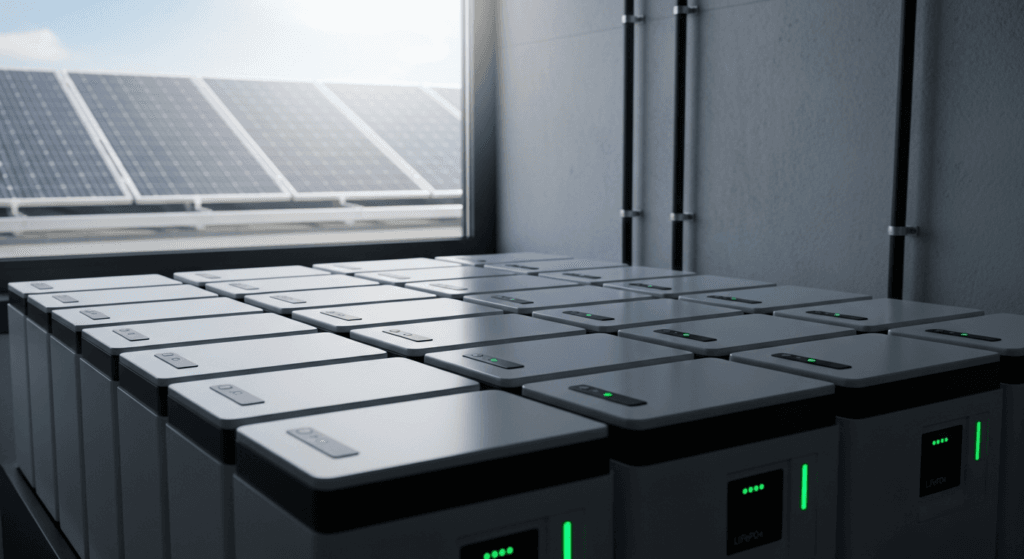
Ultimate Guide: Integrating Solar Battery Storage: A Technical Guide to System Architecture and Performance
Solar Panel Storage Battery: The Ultimate 2026 Guide to System Architecture and Performance
A solar panel storage battery system is no longer a fringe concept for off-grid enthusiasts; it is the core technical component of the 2026 energy transition. As CTO of SolarKiit, I’ve benchmarked the evolution of these systems from simple lead-acid backups to the sophisticated, grid-interactive lithium-iron-phosphate (LiFePO4) powerhouses we engineer today. The landscape is shifting rapidly. We’re moving beyond basic energy independence towards a future of optimized self-consumption, resilience against increasingly fragile utility grids, and active participation in energy markets. The technical imperative for engineers and prosumers is to look past the marketing specifications and understand the fundamental physics, component synergy, and regulatory frameworks that define a high-performance system. This guide is engineered to provide that deep understanding. It’s not about what these systems do; it’s about why they perform, how to calculate their true value, and how to verify their safety and longevity. At SolarKiit, our mission, as detailed on our About page, is to empower users with this knowledge. We will dissect the electron’s journey from photon to appliance, demystify the complex handshake between the BMS and inverter, and provide the mathematical tools to size a system for maximum ROI, not just for survival. This is the definitive masterclass for anyone serious about mastering solar energy storage.
The Core Physics and Component Synergy of a Integrating Solar Battery Storage
To truly master the integration of a solar panel storage battery, one must first understand the fundamental principles governing the flow of energy. This journey begins with a single photon and ends with a fully powered home, orchestrated by a symphony of advanced electronic components. It’s a process that blends quantum mechanics, electrochemistry, and sophisticated power electronics.
The Physics: From Photon to Stored Electron
The entire process is initiated by the photovoltaic effect. When photons from the sun, carrying energy greater than the silicon’s band gap, strike a solar panel, they excite electrons, creating electron-hole pairs. This generates a direct current (DC). The efficiency of this initial energy harvest is a critical variable, with top-tier research cells constantly pushing the theoretical limits, as tracked by the NREL Solar Efficiency Standards. However, harvesting these electrons is only the first step.
The real magic happens in the chemical storage medium. In today’s most advanced systems, this is almost exclusively a Batterie Solaire LiFePO4. The “why” behind this choice is its inherent safety and longevity, rooted in its chemistry. During charging, DC electricity from the solar panels forces lithium ions (Li+) to de-intercalate (be extracted) from the LiFePO4 cathode. These ions travel through an electrolyte and intercalate (insert themselves) into the layers of the graphite anode. The electrons, unable to pass through the electrolyte, are forced through the external circuit—your system’s wiring—to the anode, thus storing potential energy. During discharge, the process reverses: lithium ions flow back to the cathode, and the electrons flow through the external circuit, releasing the stored energy to power your home. The olivine crystal structure of LiFePO4 is exceptionally stable, resisting oxygen release even under stress, which is the primary mechanism that leads to thermal runaway in other lithium chemistries like NMC (Nickel Manganese Cobalt).
Component Synergy: The Digital Handshake
A modern energy storage system is not a mere collection of parts; it is a networked ecosystem where each component communicates to optimize performance and ensure safety. This “digital handshake,” typically managed over a CAN (Controller Area Network) bus, is the difference between a cobbled-together system and a professionally engineered solution.
- Battery Management System (BMS): The BMS is the brain of the battery pack. It is far more than a simple fuse. Its primary role is to protect the cells by monitoring voltage, current, and temperature with extreme precision. It performs active or passive cell balancing to ensure all cells in the pack charge and discharge uniformly, preventing any single cell from being overstressed. The BMS calculates the State of Charge (SoC) and, critically, the State of Health (SoH), providing the data needed to forecast the battery’s remaining lifespan.
- Maximum Power Point Tracker (MPPT): The MPPT charge controller acts as the translator between the solar array and the battery. The voltage and current produced by a solar panel array fluctuate constantly with sunlight (irradiance) and temperature. The MPPT’s algorithm continuously sweeps this I-V curve to find the “maximum power point”—the precise voltage and current combination that yields the highest wattage (P=V*I)—and adjusts the load to extract every possible watt from your panels.
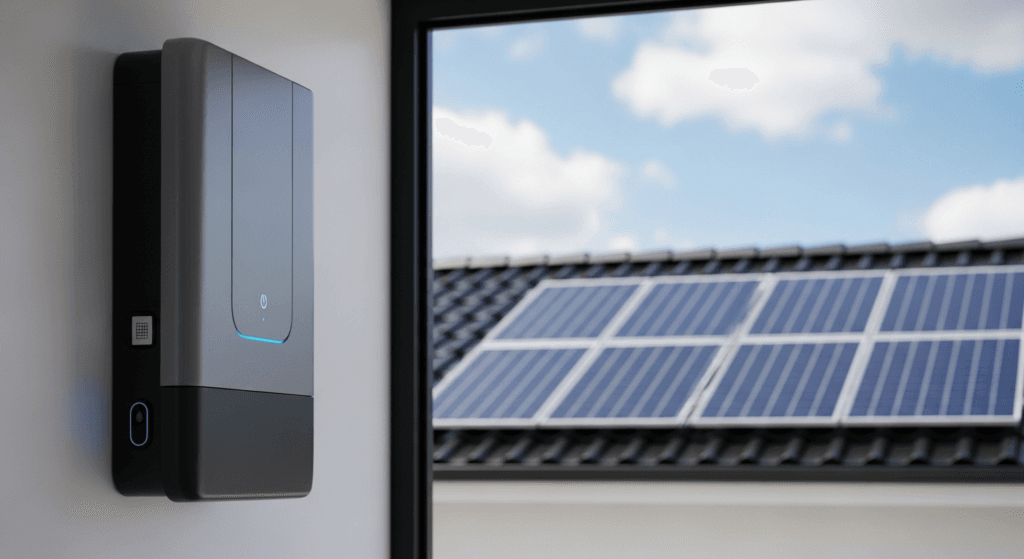
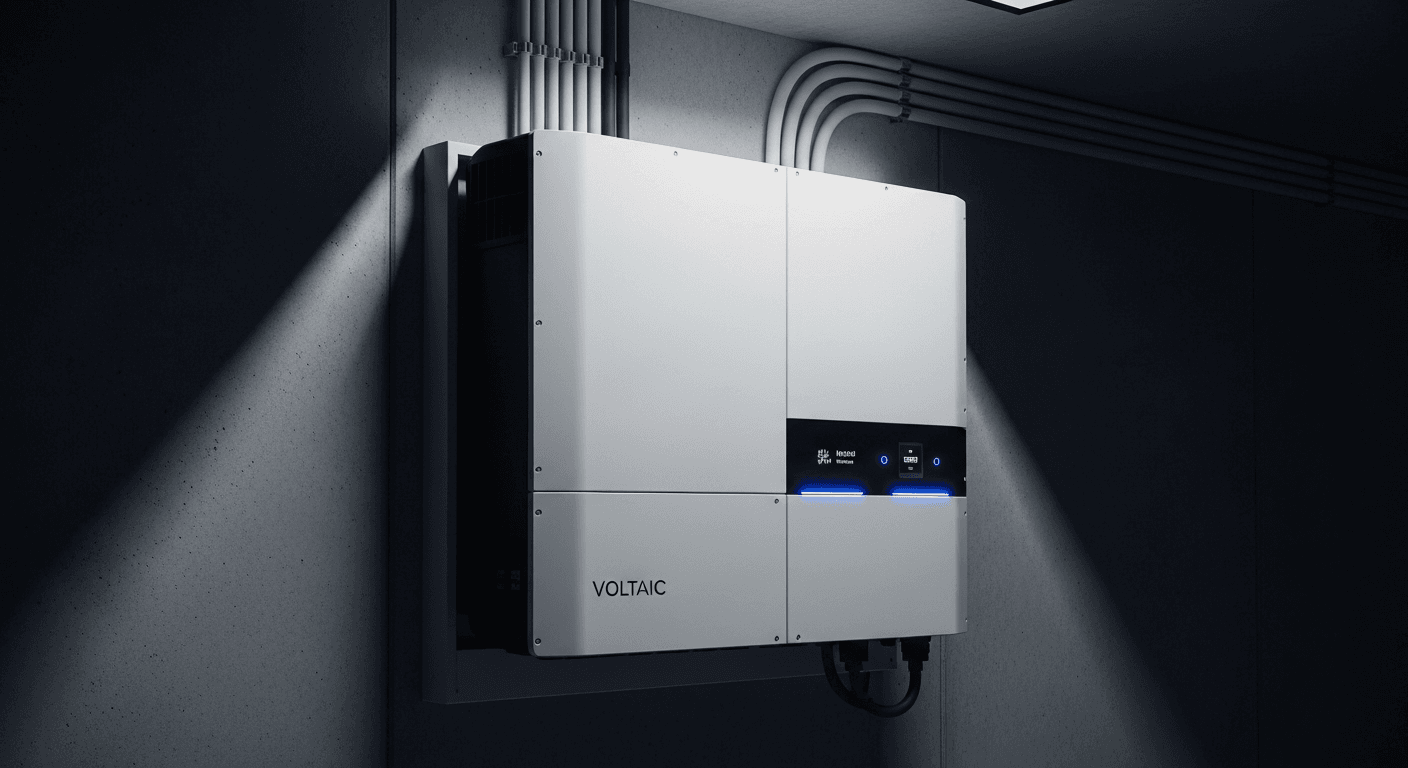
- Hybrid Inverter: The inverter is the heart of the system, converting DC power from the panels and battery into grid-synchronous AC power for your home’s appliances. Modern hybrid inverters are masterpieces of integration, often containing the MPPT charge controller, battery charger/discharger, and grid-interactive functionality in a single chassis. The efficiency of this conversion process is paramount; for a detailed analysis, see our guide on Solar Inverter Efficiency. The inverter manages the flow of energy, deciding whether to send solar power to the loads, the battery, or the grid, based on pre-programmed logic (e.g., self-consumption, time-of-use optimization).
Engineering Math: How to Correctly Size Your Solar Panel Storage Battery
Sizing an energy storage system is a technical exercise that goes far beyond a simple kWh number. Incorrect sizing leads to a poor return on investment, premature battery degradation, or insufficient power during a critical outage. The goal is to calibrate the system to your specific energy needs and goals, whether for off-grid living or grid-tied resilience.
The foundational formula for determining battery capacity is:
Battery Capacity (kWh) = (Daily Energy Consumption (kWh) × Days of Autonomy) / (Depth of Discharge (DoD) × Round-Trip Efficiency)
Let’s break down these critical engineering variables:
- Load Profile Analysis: Your “Daily Energy Consumption” is not a single number from your utility bill. A proper analysis requires identifying your critical loads (refrigerator, well pump, medical devices, communications) versus your non-essential loads. You must also account for Surge Capacity. Appliances with motors, like air conditioners or pumps, draw a massive inrush current for a few seconds on startup. Your inverter and battery must be rated to handle this surge without voltage sag or system shutdown.
- Days of Autonomy: This specifies how many consecutive days the system can power your critical loads with zero solar input. For grid-tied backup, 1-2 days is common. For those building the best off-grid solar kits of 2024, 3-5 days is a safer standard, depending on the regional climate and sun hours.
- Depth of Discharge (DoD) & Efficiency: LiFePO4 batteries can be discharged deeper than older chemistries, but consistently discharging to 100% will shorten their lifespan. A conservative DoD of 80-90% is standard practice to maximize cycle life. Understanding Round-Trip Efficiency is also crucial; this accounts for energy lost as heat during the charge and discharge cycles. A typical LiFePO4 system has a round-trip efficiency of 90-95%, meaning for every 10 kWh you put in, you get 9.0-9.5 kWh out.
Master Comparison: 2026 Industry-Leading Solar Storage Models
To provide a clear engineering benchmark, we’ve compiled a comparison of five leading models. Note that LCOE (Levelized Cost of Storage) is a calculated metric representing the cost per kWh delivered over the battery’s lifetime, a far more useful metric than upfront cost.
| Model | Chemistry | Usable Capacity (kWh) | Cycle Life (@ 80% DoD) | LCOE (Est. $/kWh) | Warranty (Years/Cycles) |
|---|---|---|---|---|---|
| SolarKiit SK-15 | LiFePO4 | 14.8 | 8,000+ | $0.11 | 15 Years / 8,000 |
| Tesla Powerwall 3 | NMC | 13.5 | ~4,000 | $0.18 | 10 Years / Unlimited |
| Enphase IQ Battery 5P | LiFePO4 | 5.0 (Modular) | 6,000+ | $0.15 | 15 Years / 6,000 |
| FranklinWH aPower | LiFePO4 | 13.6 | ~4,500 | $0.17 | 12 Years / 43 MWh Throughput |
| SolarEdge Energy Bank | NMC | 10.0 | ~4,000 | $0.19 | 10 Years / Unlimited |
Regulatory & Safety Analysis: NEC 2026, UL 9540, and Fire Protocols
A high-performance system is useless if it’s not safe and compliant. The regulatory landscape is complex and non-negotiable. As engineers, we must design systems that not only meet but exceed these standards to ensure the safety of property and personnel. While a comprehensive DIY solar panel installation guide can be useful for arrays, energy storage systems introduce complexities that often require professional certification.
NEC 2026 and UL 9540: The Gold Standards
The National Electrical Code (NEC), specifically Article 706 (Energy Storage Systems), provides the foundational rules for installation. We anticipate the 2026 NEC cycle will further strengthen requirements around cybersecurity for grid-interactive systems and refine rapid shutdown protocols (NEC 690.12) to better integrate with ESS. These codes dictate everything from conductor sizing and overcurrent protection to physical disconnects and signage.
However, the single most important safety certification to verify is UL 9540. This is not a battery standard; it is a system standard. It certifies that the battery, inverter, BMS, and enclosure have been tested together as a complete and integrated unit. It is the benchmark for system-level safety. A critical component of this is the UL 9540A test method. This is a large-scale fire test that evaluates the risk of thermal runaway propagation. A system that has passed UL 9540A testing has demonstrated that if one cell fails, the failure will not cascade to adjacent cells or escape the enclosure, drastically reducing fire risk. When selecting a system, demanding proof of both UL 9540 and UL 9540A testing is a non-negotiable step in your due diligence, alongside adherence to global benchmarks like the IEC Solar Safety Standards.
Fire Safety and Installation Protocols
Physical installation is the final link in the safety chain. Best practices, often mandated by the local Authority Having Jurisdiction (AHJ), include:
- Clearance and Ventilation: All systems require specific clearances around them for ventilation to dissipate heat and for service access. These specifications are not suggestions.
- Location: While modern LiFePO4 systems are incredibly safe, installation in non-habitable spaces like garages or basements is always preferred. Outdoor installations must be protected from direct sun and extreme temperatures.
- Physical Protection: For installations in a garage, installing protective bollards to prevent accidental vehicle impact is a simple but critical safety measure.
For any questions regarding our own compliance or data handling, please review our Privacy Policy.
The Pillar FAQ: Advanced Engineering Questions
1. AC-Coupling vs. DC-Coupling: Which architecture offers superior round-trip efficiency for retrofitting an existing solar installation?
AC-coupling is generally more straightforward for retrofits, but DC-coupling often provides a slight edge in round-trip efficiency for new, integrated systems. The choice hinges on the number of power conversions.
- In a DC-coupled system, power flows from the PV panels (DC) through the MPPT charge controller (DC) to the battery (DC). When power is needed, it flows from the battery (DC) to the hybrid inverter and out to the home (AC). This involves only one DC-to-AC conversion for stored energy.
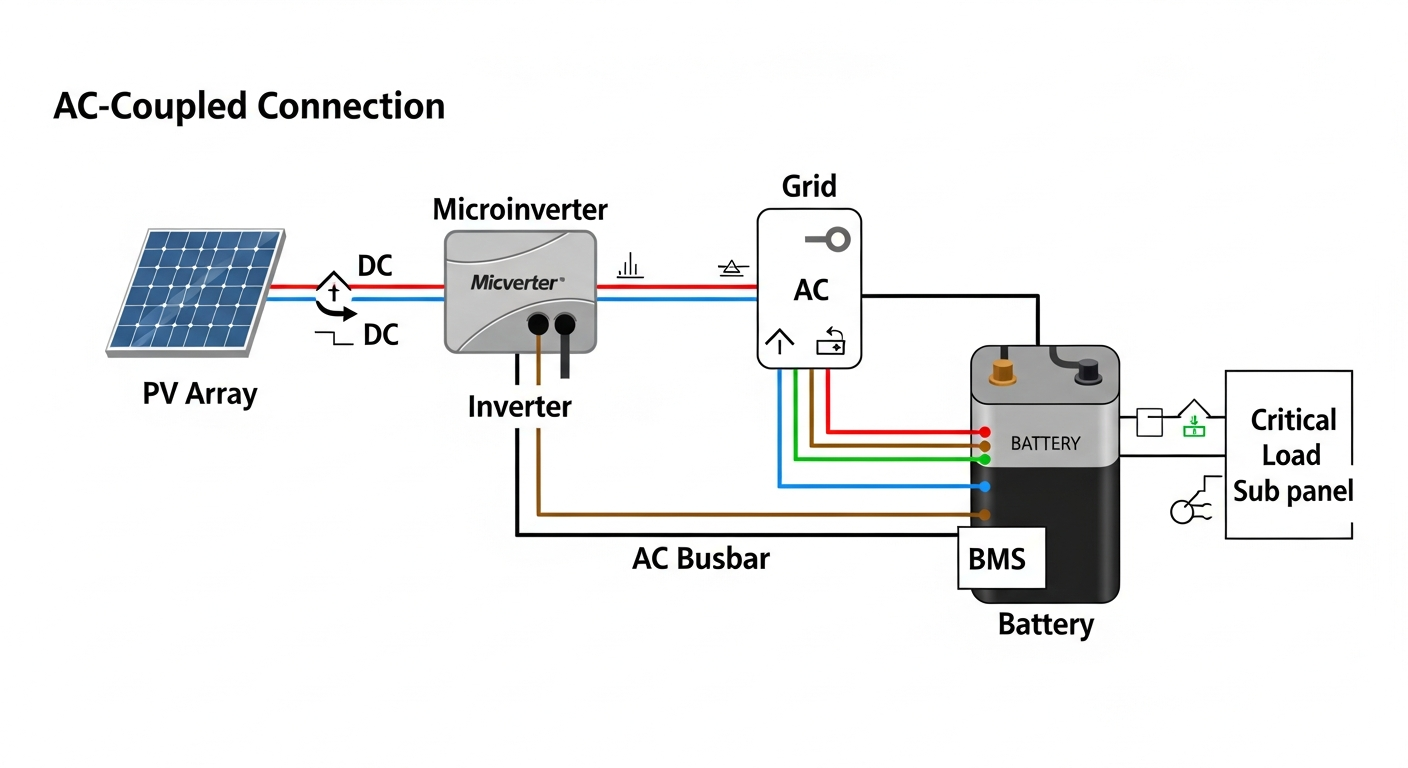
- In an AC-coupled system, typically used for retrofits, the existing PV array already has its own grid-tied inverter converting power to AC. To store this energy, a separate battery inverter must convert it back to DC to charge the battery. To use the stored power, it’s converted back to AC again. This DC -> AC -> DC -> AC pathway involves three conversions, each incurring a small efficiency loss (typically 2-4%). While simpler to install, this “conversion penalty” results in a lower overall round-trip efficiency compared to a well-designed DC-coupled system.
2. Can a solar panel storage battery system operate during a grid outage without a dedicated critical load panel?
Yes, this is possible using a system with a whole-home backup configuration, which requires a specific type of automatic transfer switch (ATS) or a smart panel.
- The traditional method involves an electrician moving your home’s essential circuits (e.g., refrigerator, lights, well pump) into a separate “critical load” sub-panel. During an outage, only this sub-panel is energized by the battery system.
- Modern solutions, however, offer more flexibility. A system with an integrated ATS or a “smart panel” (like the Span panel) places the transfer switch between your utility meter and your main electrical panel. When the grid fails, it disconnects the entire home from the grid and allows the inverter to form a local microgrid, powering the whole house. The intelligence of the system comes from its ability to monitor the total load and dynamically “shed” or turn off non-essential, high-power circuits (like an EV charger or electric dryer) if the load exceeds the inverter’s capacity or to conserve battery life. This provides greater convenience without sacrificing resilience.
3. How does temperature de-rating affect the real-world performance and ROI of a LiFePO4 battery?
Temperature de-rating significantly reduces both the available capacity and power output of a battery outside its optimal range (typically 15-25°C), directly impacting the system’s ROI by limiting self-consumption and backup duration.
- This is a critical factor often overlooked in marketing materials. At low temperatures, the electrochemical process slows down, increasing internal resistance and reducing the battery’s ability to deliver power. The BMS will actively limit the charge and discharge rate to prevent lithium plating, a form of degradation. For example, a 10 kWh battery may only be able to deliver 7 kWh of energy at 0°C.
- At high temperatures, the risk of accelerated degradation increases. The BMS will again throttle performance to keep cell temperatures within a safe operating window. This de-rating directly impacts ROI by reducing the amount of solar energy you can store and use during peak-rate evening hours. It underscores the engineering importance of installing the battery in a thermally stable environment, such as an insulated garage or basement, rather than on an exterior wall exposed to direct sunlight or freezing temperatures.
4. What is “voltage sag” and how does a high-quality BMS and inverter combination mitigate it when starting large motor loads?
Voltage sag is a momentary drop in system voltage due to high inrush current, which a premium BMS and inverter mitigate through advanced power electronics and capacitor banks.
- When a large inductive load like an air conditioner compressor or well pump starts, it can draw an “inrush current” that is 5 to 8 times its normal running current. This massive, instantaneous demand for power can pull the battery’s voltage down sharply.
- In a lower-quality system, this voltage sag can be severe enough to cause lights to flicker, sensitive electronics to reboot, or the inverter to trip offline on an undervoltage fault. A high-quality inverter is engineered with large internal capacitors that act as a short-term power buffer, supplying the initial milliseconds of the surge. Simultaneously, its control algorithm communicates with the BMS, which is programmed to allow a very brief, high-current discharge from the battery cells that exceeds the continuous rating but stays within a safe peak limit. This synergistic response satisfies the motor’s inrush current, minimizing voltage sag and ensuring a smooth, reliable startup.
5. Beyond simple backup, what are the advanced grid service functions a modern solar panel storage battery can perform to generate revenue?
Modern systems can participate in Demand Response, Frequency Regulation, and Virtual Power Plant (VPP) programs, generating revenue by stabilizing the local grid.
- This transforms the battery from a passive backup device into an active grid asset. These functions require a certified, grid-interactive inverter and enrollment in a program with your utility or a third-party aggregator.
- Demand Response: You get paid by the utility to automatically discharge your battery to the grid (or reduce your home’s consumption) during peak demand events, helping the utility avoid firing up expensive and dirty “peaker” power plants.
- Frequency Regulation: The system makes millisecond-level adjustments, charging or discharging tiny amounts of energy to help keep the grid’s frequency stable at exactly 60 Hz. This is a valuable ancillary service for grid operators.
- Virtual Power Plants (VPPs): An aggregator bundles thousands of residential batteries like yours, creating a large, distributed power plant. They can then bid this collective capacity into wholesale energy markets, sharing the revenue with the homeowners. As more data from organizations like SEIA Market Insights shows, VPPs are a rapidly growing segment of the renewable energy economy.
For a technical consultation on your specific project, please contact our engineering team. We are committed to designing and deploying the most robust and efficient systems, including the versatile portable power station and the powerful solar panel storage battery.
📥 Associated Resource:

El Kouriani Abde Civil Engineer & Founder of SolarKiit
El Kouriani Abde is a seasoned Civil Engineer and Project Manager with over 21 years of field experience. As the founder and publisher of SolarKiit.com, he leverages his deep technical background to simplify complex renewable energy concepts. His mission is to provide homeowners and professionals with accurate, engineering-grade guides to maximize their solar investments and achieve energy independence.