Batteries Solaires LiFePO4 : Le Guide Ultime pour l’Énergie Renouvelable
Strategic Overview: The 2026 LiFePO4 Imperative
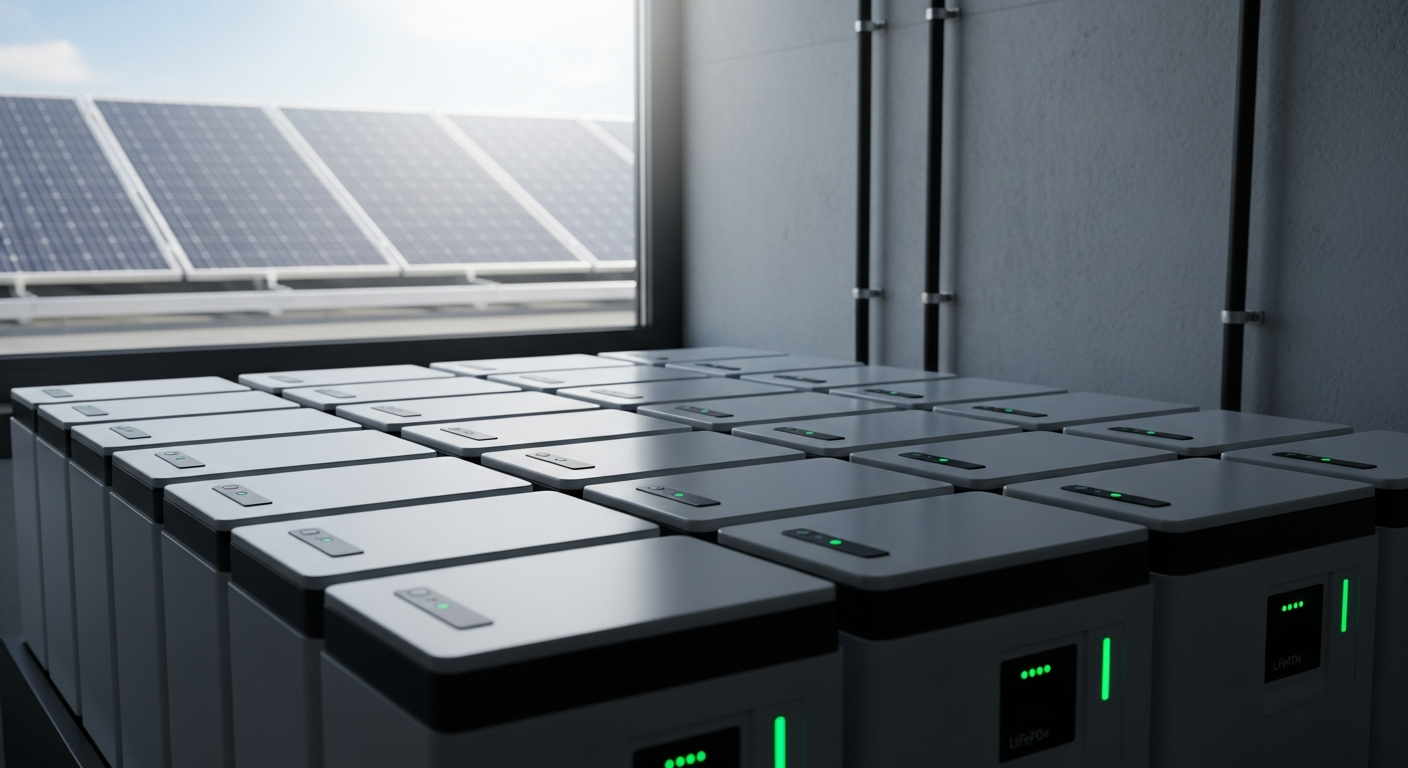
As we advance into 2026, the landscape of residential and commercial energy storage has fundamentally shifted. The era of choice has given way to the era of necessity, driven by escalating grid instability, dynamic utility pricing, and a global mandate for decarbonization. In this new paradigm, energy storage is no longer a luxury for early adopters but a core component of modern energy infrastructure. At the forefront of this revolution is the Lithium Iron Phosphate (LiFePO4) battery chemistry.
By 2026, LiFePO4 has definitively eclipsed older lithium-ion chemistries like Nickel Manganese Cobalt (NMC) and Nickel Cobalt Aluminum (NCA) for stationary storage applications. This dominance is not accidental; it is the result of a market correction prioritizing long-term value, operational safety, and supply chain ethics over marginal gains in energy density. The inherent thermal stability of the phosphate-based cathode makes LiFePO4 systems fundamentally safer, a critical factor for in-home installations.
Furthermore, the maturation of the global LiFePO4 supply chain, free from the cobalt dependencies that plague other chemistries, has driven costs down to unprecedented levels. This economic advantage, coupled with cycle lives now routinely exceeding 6,000-10,000 cycles, presents an undeniable total cost of ownership (TCO) benefit. For the modern energy prosumer, investing in a LiFePO4-based solar energy system is the most logical, financially sound, and secure step towards achieving true energy independence.
Deep Technical Analysis: From Photon to Stored Electron
Understanding the superiority of a LiFePO4 solar system requires a granular analysis of its constituent parts and the physics governing their interaction. A complete system is an engineered ecosystem where every component’s efficiency compounds to determine the final usable energy delivered to your loads.
The Physics of Energy Conversion and Storage
The process begins at the photovoltaic (PV) array. Solar panels, predominantly composed of monocrystalline TOPCon (Tunnel Oxide Passivated Contact) or HJT (Heterojunction) cells in 2026, leverage the photovoltaic effect. When photons strike the silicon, they excite electrons, creating a direct current (DC) potential. The specific orientation and tilt of this PV array are critical variables, engineered to maximize solar irradiance capture based on geographic latitude and seasonal sun paths.
This raw DC power is channeled to a Maximum Power Point Tracking (MPPT) charge controller. The MPPT is a sophisticated DC-to-DC converter that constantly adjusts its internal resistance to find the optimal voltage and current (the ‘maximum power point’) of the solar array. This ensures maximum energy harvest, with modern MPPTs achieving efficiencies greater than 99%, a stark improvement over older PWM controllers.
From the MPPT, the optimized DC current flows to the LiFePO4 battery bank. Inside each cell, the charging process involves the intercalation of lithium ions (Li+) from the iron phosphate (FePO4) cathode, through an electrolyte, into the graphite anode. The reverse occurs during discharge. The key to LiFePO4’s stability is the robust covalent P-O bond within the phosphate olivine structure, which prevents oxygen release during overcharge or thermal stress—the primary trigger for thermal runaway in NMC/NCA cells.
Finally, to power household appliances, the battery’s stored DC energy must be converted to alternating current (AC). This is the role of the inverter. It is critical to use a Pure Sine Wave inverter, which produces a clean, smooth AC waveform identical to grid power. This is non-negotiable for sensitive electronics like computers, modern refrigerators, and medical equipment, which can be damaged by the jagged output of a modified sine wave inverter.
Efficiency Benchmarks and System Sizing in 2026
System efficiency is a product of its parts. In 2026, best-in-class components feature:
- PV Module Efficiency: 23-25% for mainstream TOPCon panels. Perovskite-on-silicon tandem cells, while expensive, are emerging in niche markets with efficiencies exceeding 30%.
- Battery Round-Trip Efficiency: A LiFePO4 battery typically returns 92-95% of the energy put into it. This metric accounts for minimal energy lost as heat during charge/discharge cycles.
- Inverter Efficiency: High-frequency Pure Sine Wave inverters from leading brands achieve peak efficiencies of 97-98%.
However, total system efficiency is always lower due to parasitic losses, including voltage drop in wiring, thermal derating of components, and the standby consumption of the inverter and Battery Management System (BMS). A well-designed system aims to minimize these losses to achieve a ‘photon-to-appliance’ efficiency of 80-85%.
Load Calculation and Sizing Strategy
Proper system sizing is the most critical step in engineering a reliable solar installation. Undersizing leads to power shortages, while oversizing results in unnecessary capital expenditure.
Step 1: Conduct a Load Analysis. Meticulously list every appliance you intend to power. Calculate its daily energy consumption in Watt-hours (Wh) by multiplying its power rating (Watts) by its daily run time (hours). Sum these values to get your total daily energy requirement in kilowatt-hours (kWh).
Step 2: Calculate Required Battery Capacity. First, account for inverter inefficiency by dividing your daily kWh by the inverter’s efficiency (e.g., 0.95). Then, determine your desired days of autonomy (how many days the system can run with zero solar input). Finally, factor in the maximum Depth of Discharge (DoD). For LiFePO4, a 90% DoD is conservative and safe.
Required Capacity (kWh) = (Daily kWh / Inverter Efficiency) * Days of Autonomy / Max DoD
Step 3: Size the PV Array. The solar array must be large enough to fully recharge the battery bank while also powering daytime loads. This calculation depends on your location’s ‘Peak Sun Hours’ (PSH), a measure of daily solar insolation. Online tools like the NREL PVWatts Calculator are indispensable for this. A common rule of thumb is to size the array (in kW) to be 1.2 to 2.0 times the battery bank’s capacity (in kWh), depending on PSH.
Engineering Specifications & Innovations
The performance of a LiFePO4 battery is dictated not just by its core chemistry but by the sophisticated engineering surrounding it. The Battery Management System (BMS) is the central nervous system, and leading manufacturers differentiate themselves through software, integration, and modular design.
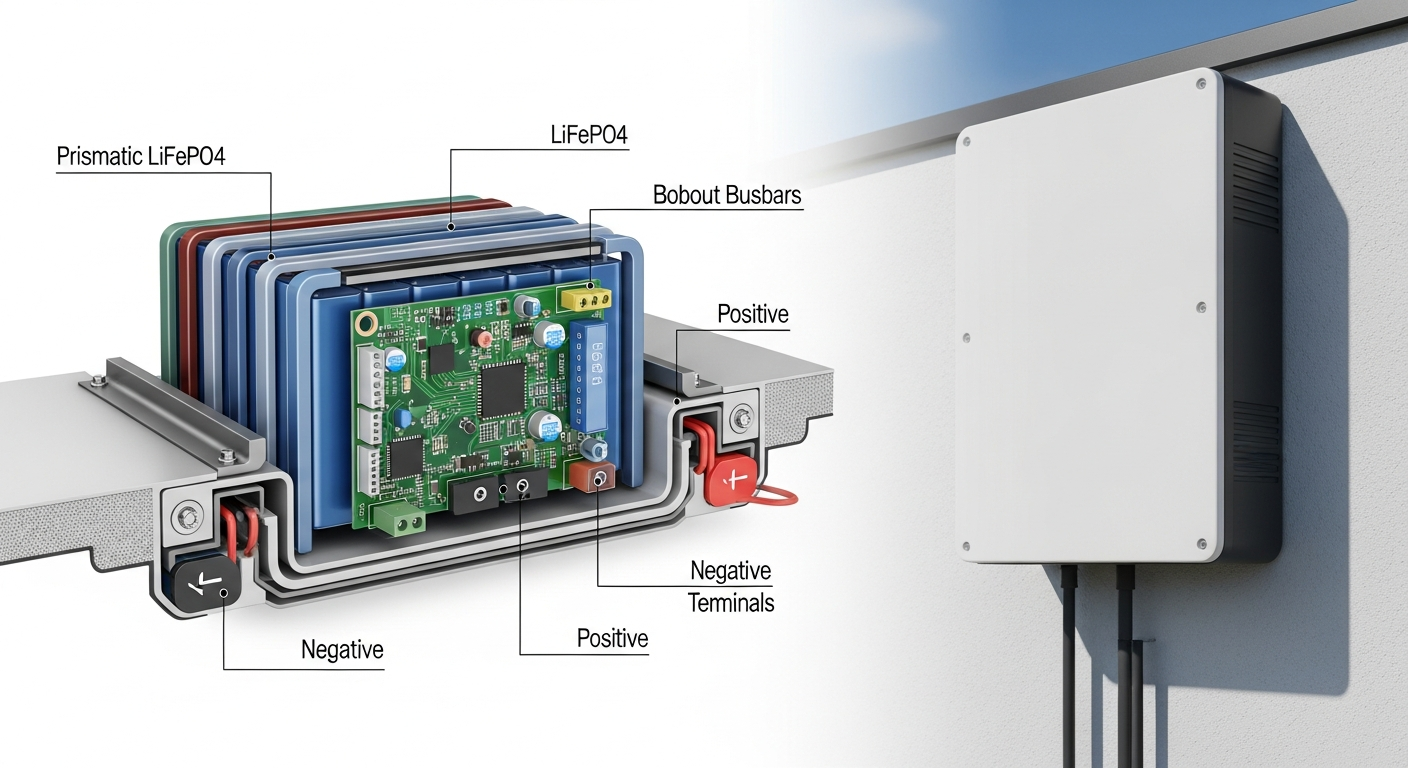
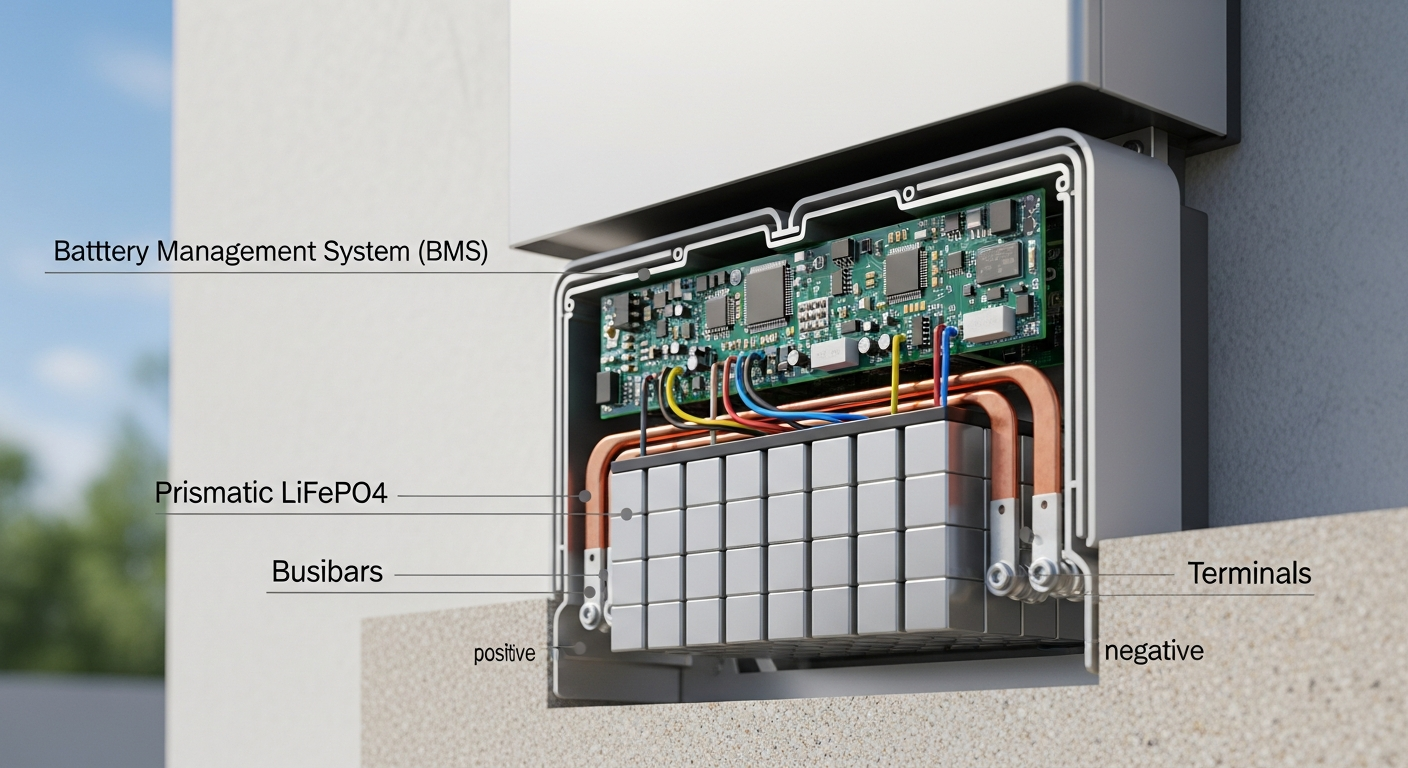
The BMS is a mandatory electronic supervisor integrated into every LiFePO4 pack. Its primary functions are mission-critical: it provides over-voltage and under-voltage protection, prevents over-current and short circuits, and performs cell balancing to ensure all cells within the pack age uniformly. Crucially, it also includes thermal monitoring, preventing charging in sub-zero temperatures (which can cause lithium plating and permanent damage) and shutting down the system in over-temperature conditions.
Brand-Specific Ecosystems and Technology
By 2026, the market has consolidated around a few key innovators who offer more than just a battery; they offer a complete energy ecosystem.
Victron Energy: The gold standard for off-grid and marine applications, Victron’s strength lies in its modularity and robust communication protocols. Their Cerbo GX acts as a central hub, integrating solar chargers, battery monitors (like the SmartShunt), inverters/chargers (MultiPlus/Quattro series), and LiFePO4 Smart Batteries. The VRM (Victron Remote Management) portal provides unparalleled remote monitoring and system control, making it a favorite for professional installers managing complex, high-reliability systems.
EcoFlow & Bluetti: These brands have revolutionized the market with highly integrated, modular systems that bridge the gap between portable power and whole-home backup. Systems like the EcoFlow DELTA Pro Ultra or Bluetti EP900 offer stackable battery modules, allowing users to scale their capacity from a few kWh to over 20 kWh. Their key innovation is combining the inverter, MPPT, and BMS into a single, user-friendly unit with high-power output, capable of running demanding 240V loads like HVAC systems.
Tesla & Enphase: While Tesla’s Powerwall was a market pioneer, by 2026 many of its new stationary storage units have transitioned to LiFePO4 chemistry to improve cycle life, safety, and align with their vehicle supply chain. Enphase offers a different architecture with its IQ Battery 5P, an AC-coupled system. In this design, each solar panel has a microinverter, and the battery has its own built-in inverter, simplifying installation and retrofitting onto existing solar arrays. The trade-off is a slight efficiency loss due to multiple DC-AC-DC conversions.
Technical Comparison of 2026 LiFePO4 Systems
| Model | Nominal Capacity | Chemistry | Cycle Life (@80% DoD) | Max Continuous Discharge | Round-Trip Efficiency | Key Feature |
|---|---|---|---|---|---|---|
| Victron Smart Lithium 25.6V/200Ah | 5.12 kWh | LiFePO4 | ~7,000 cycles | 4.0 kW (200A @ 25.6V) | ~94% | Extreme modularity for custom off-grid systems. Requires external BMS. |
| EcoFlow DELTA Pro Ultra | 6 kWh (expandable to 90 kWh) | LiFePO4 | ~6,500 cycles | 7.2 kW (expandable to 21.6 kW) | ~94.5% | Integrated inverter/MPPT. High power output for whole-home backup. |
| Bluetti EP900 & B500 | 9.9 kWh (expandable to 39.6 kWh) | LiFePO4 | ~8,000 cycles | 9.0 kW | ~93% | Split-phase 120V/240V output standard. Seamless grid/off-grid switching. |
| Enphase IQ Battery 5P | 5.0 kWh | LiFePO4 | ~6,000 cycles | 3.84 kW | ~90% (AC-coupled) | AC-coupled design for easy retrofitting. Integrates with Enphase microinverters. |
| SolarKiit Pro LFP 15 | 15.0 kWh | LiFePO4 (Prismatic Cells) | ~10,000 cycles | 10.0 kW | ~95.5% | Server-rack form factor for high-density installs. Advanced thermal management. |
Safety Protocols & Regulatory Standards
The safe installation and operation of an Energy Storage System (ESS) is paramount. Adherence to established codes and standards is not optional; it is a legal and ethical requirement for any installer. The inherent safety of LiFePO4 chemistry reduces risk, but it does not eliminate the dangers associated with high-voltage DC electricity.
Electrical Codes and Certifications
In the United States, all installations must comply with the National Electrical Code (NEC). Key articles include NEC Article 480 for storage batteries and NEC Article 705 for interconnected power sources. These codes dictate requirements for disconnects, overcurrent protection (fuses and breakers), wire sizing (gauging), and grounding. Proper wire gauging is critical to prevent excessive voltage drop and, more dangerously, overheating that can lead to fire.
All system components must be listed by a Nationally Recognized Testing Laboratory (NRTL), with Underwriters Laboratories (UL) being the most common. Key certifications to look for are UL 1741 for inverters and charge controllers, UL 1973 for batteries, and most importantly, UL 9540 for the entire pre-packaged Energy Storage System. UL 9540 ensures all components have been tested to work together safely.
Fire Safety and Thermal Runaway Mitigation
While LiFePO4 is exceptionally resistant to thermal runaway, a comprehensive safety strategy is still necessary. The UL 9540A test standard is a rigorous method for evaluating fire propagation in battery systems. Systems with this certification have demonstrated a low risk of cell-to-cell fire propagation. The BMS provides the first line of defense, constantly monitoring cell temperatures and disconnecting the battery if thresholds are exceeded.
Physical installation practices are also critical. Batteries must be installed with adequate clearance from combustible materials as specified by the manufacturer and local fire codes. Proper ventilation is required to dissipate the small amount of heat generated during operation. While a LiFePO4 fire is rare, a Class ABC multi-purpose dry chemical fire extinguisher should be readily accessible in the vicinity of the installation.
Environmental Ingress Protection (IP Ratings)
IP ratings define a component’s resistance to dust and water. An IP65 rating, common for inverters and outdoor-rated battery enclosures, indicates the unit is dust-tight and protected against water jets from any direction. For components in areas with a higher risk of water exposure, an IP67 rating ensures protection against temporary immersion in water, providing a superior level of durability and safety.
Pre-Installation Operational Checklist
- Structural Assessment: Confirm the structural integrity of the mounting surface (roof for panels, wall for batteries/inverters) to support the total system weight.
- Comprehensive Load Analysis: Complete a detailed audit of all electrical loads to verify that the system sizing (PV array, battery capacity, inverter power) is adequate.
- Permitting and Utility Agreements: Verify and secure all necessary local building permits and, for grid-tied systems, a signed interconnection agreement with your utility provider.
- Component Compatibility Verification: Ensure all selected components (panels, charge controller, inverter, battery) are certified and confirmed to be compatible, especially regarding communication protocols and voltage ranges.
- Cable Run Planning: Design the DC and AC cable runs to be as short and direct as possible to minimize voltage drop, cost, and potential points of failure.
- Safety and Disconnect Plan: Map out the locations for all required safety disconnects, fuses, and circuit breakers in accordance with NEC guidelines for easy access and emergency shutdown.
- Environmental Review: Assess the installation location for potential environmental hazards such as flooding, extreme temperatures, or direct sunlight on sensitive components, and ensure IP ratings are appropriate.
Advanced Technical FAQ
What are the engineering trade-offs between an AC-coupled and a DC-coupled LiFePO4 system?
A DC-coupled system is generally more efficient for new installations. Solar energy flows from the PV array to the charge controller and directly into the battery (DC to DC), only being inverted to AC when needed by loads. An AC-coupled system, often used for retrofitting batteries to an existing grid-tied solar array, converts the panels’ DC power to AC via microinverters, then the battery’s inverter converts it back to DC to charge the battery, and finally back to AC for loads. This DC-AC-DC-AC conversion path introduces more efficiency losses but simplifies installation significantly.
Can I mix LiFePO4 batteries of different capacities, brands, or ages in the same bank?
From an engineering standpoint, this is strongly discouraged. Mixing batteries, even of the same chemistry, leads to imbalances. The BMS will struggle to manage cells with different internal resistances, states of health, and capacities. The entire bank’s performance will be limited by the weakest battery, leading to premature degradation, reduced usable capacity, and potential safety issues as the BMS may fail to balance the cells properly. Always use identical batteries from the same batch for parallel or series connections.
What is the real-world impact of C-rate on my LiFePO4 battery’s cycle life?
C-rate measures the charge or discharge current relative to the battery’s capacity (1C for a 100Ah battery is a 100A current). While many LiFePO4 batteries are rated for high C-rates (e.g., 1C continuous, 2C peak), consistently operating at these limits accelerates degradation. High currents generate more internal heat and put greater physical stress on the electrode materials. For maximum longevity, it is best practice to design your system so that typical discharge rates are between 0.2C and 0.5C. This conservative approach is a key factor in achieving a 15-20 year service life.
How does ambient temperature specifically affect LiFePO4 performance and health?
LiFePO4 chemistry has an optimal operating range, typically 15°C to 35°C (60°F to 95°F). In cold temperatures (below 5°C), the internal resistance increases, reducing available capacity and power output. Critically, charging a LiFePO4 battery below 0°C (32°F) can cause lithium plating on the anode, a form of irreversible damage. A quality BMS will prevent charging in these conditions. High temperatures (above 45°C) accelerate chemical degradation of the electrolyte and electrodes, permanently reducing the battery’s lifespan.
Is a 48V nominal system always technically superior to a 24V or 12V system?
For larger systems (>3kWh), a 48V architecture is almost always superior. According to Ohm’s Law (P=V*I), for the same power (P), doubling the voltage (V) halves the current (I). Lower current allows for the use of smaller, less expensive copper wiring, significantly reduces resistive losses (voltage drop), and increases overall system efficiency. While 12V and 24V systems are viable for small, simple applications (RVs, small cabins), the efficiency gains and component availability for 48V systems make them the professional standard for residential and off-grid homes.
📥 Associated Resource:

El Kouriani Abde Civil Engineer & Founder of SolarKiit
El Kouriani Abde is a seasoned Civil Engineer and Project Manager with over 21 years of field experience. As the founder and publisher of SolarKiit.com, he leverages his deep technical background to simplify complex renewable energy concepts. His mission is to provide homeowners and professionals with accurate, engineering-grade guides to maximize their solar investments and achieve energy independence.