Panneau Solaire Bifacial : Guide Complet, Prix et Rendement 2024
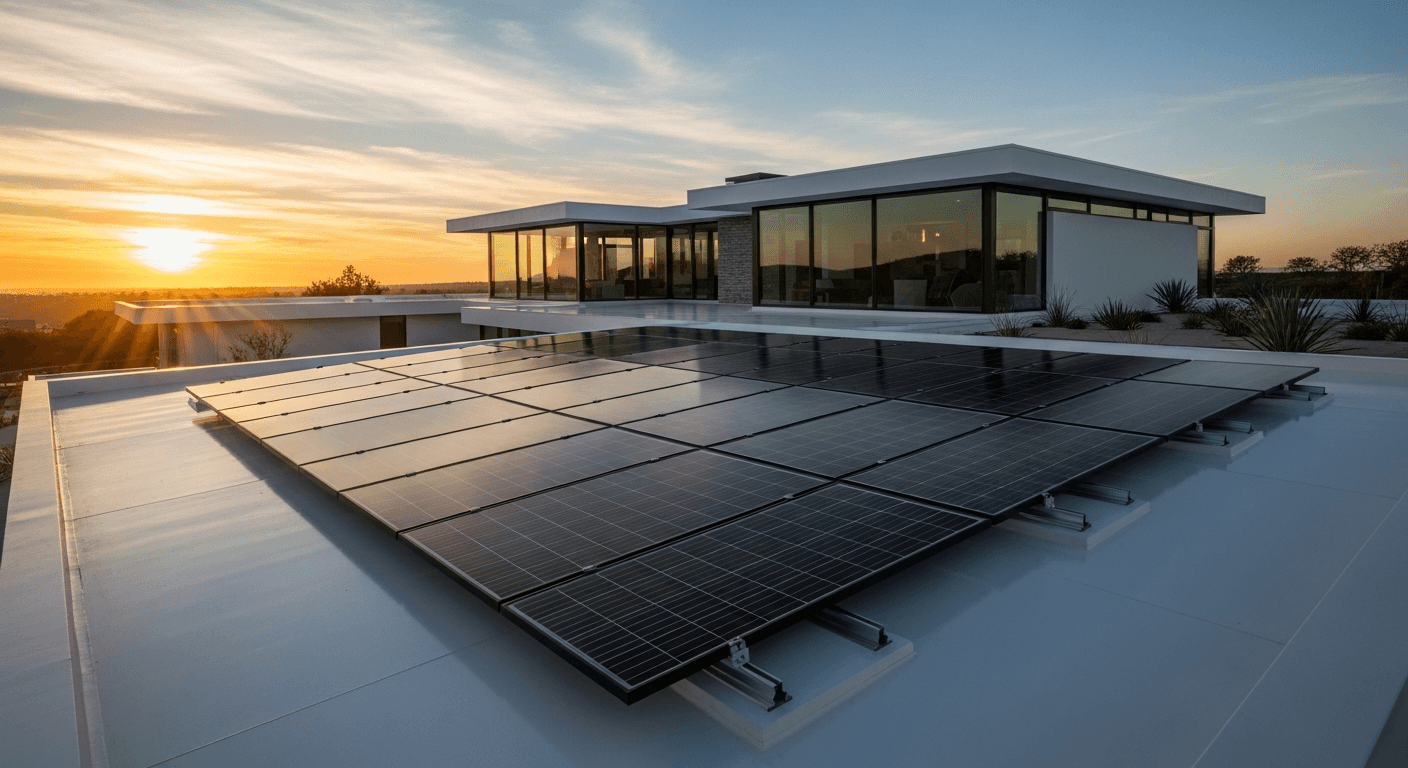
A home battery storage system is the cornerstone of modern energy independence, and by 2026, its synergy with advanced photovoltaic technology like bifacial solar panels has become the gold standard for residential power. While traditional monofacial panels have served us well, the future of maximizing self-consumption and achieving grid resilience lies in capturing every possible photon. Bifacial panels, with their ability to generate power from both sides, offer a significant increase in energy yield, directly translating to faster charging, greater energy reserves, and a more robust power supply during grid outages or periods of low sunlight.
This guide moves beyond the basics, offering a deep engineering analysis of how to pair bifacial solar arrays with a state-of-the-art home battery storage system. We will dissect the technical specifications, from cell chemistry to inverter topology, that define a high-performance system in 2026. Understanding these principles is no longer optional; it is critical for anyone serious about optimizing their investment, ensuring safety, and securing their energy future against the backdrop of an evolving and often unpredictable energy landscape.
As we look at the market, the integration of these two technologies is driven by economics and performance. Higher bifacial gain, especially when installed over reflective surfaces, reduces the payback period of a home battery storage system by maximizing the amount of self-generated, “free” energy stored and used. This comprehensive analysis will provide the technical foundation you need to design and implement a system that is not only powerful but also intelligent and resilient for years to come.
Deep Technical Analysis of Bifacial PV and Battery Integration
The core of a solar energy system is the conversion of light into electrical energy. In 2026, the dominant technology for high-efficiency bifacial panels is the N-type Tunnel Oxide Passivated Contact (TOPCon) cell. Unlike older P-type PERC cells, N-type silicon is less susceptible to Light Induced Degradation (LID) and boasts a higher bifaciality factor, often exceeding 85%. This means the rear side of the cell can generate up to 85% of the power of the front side under ideal irradiance conditions (1000 W/m²).
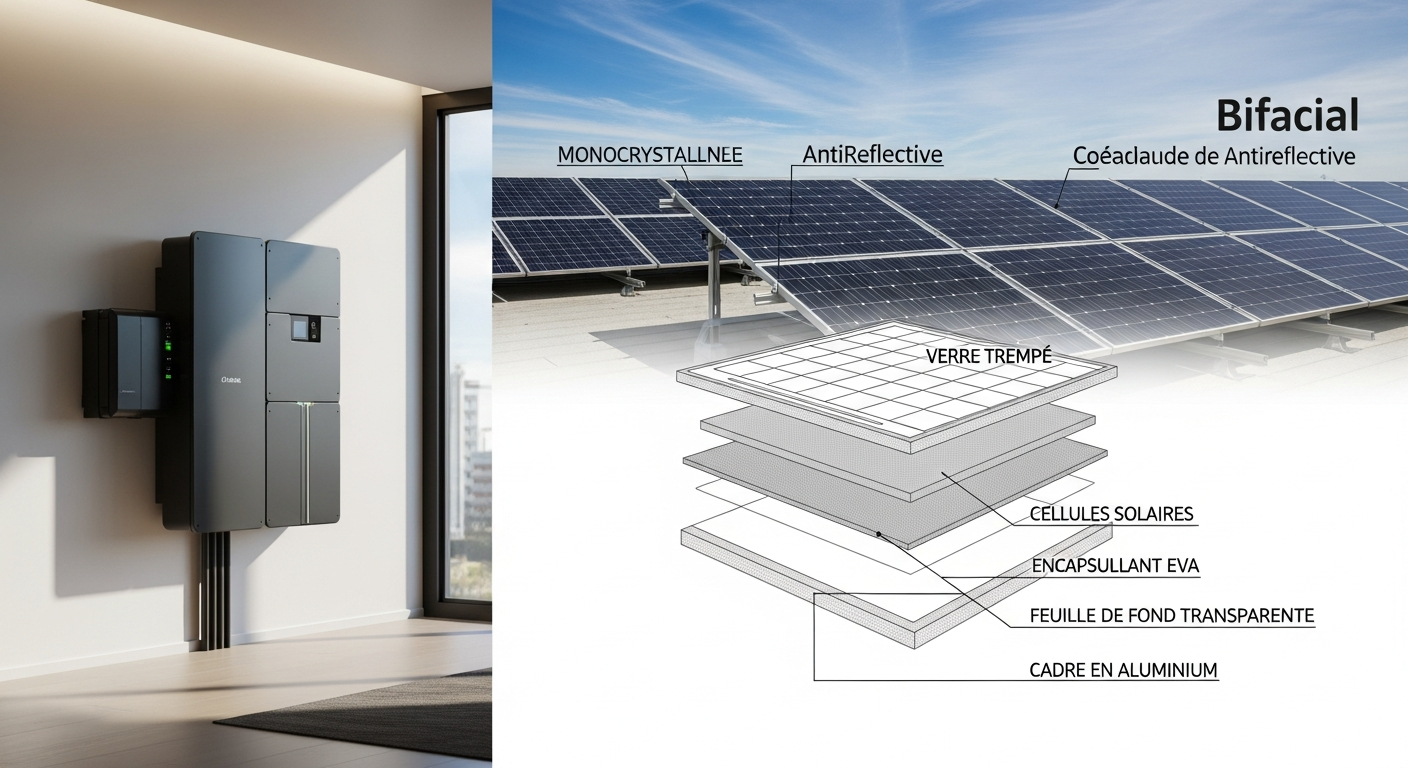
The physics involves the photovoltaic effect, where photons strike the silicon, creating electron-hole pairs. In a bifacial cell, this occurs on both surfaces. The front side captures direct and diffuse sunlight, while the rear side absorbs ground-reflected radiation, known as albedo. The total power output (P_total) is the sum of the front-side power (P_front) and the rear-side power (P_rear), which is a product of the ground-reflected irradiance (GRI), rear-side efficiency, and the bifaciality factor. This “bifacial gain” can add anywhere from 5% to 30% to the total energy yield.
This enhanced DC output is then managed by a Maximum Power Point Tracking (MPPT) charge controller. A crucial component, the MPPT continuously adjusts the electrical operating point of the modules to extract the maximum available power. For bifacial systems, advanced MPPT algorithms that can adapt to the variable rear-side generation are critical. The harvested DC energy is then used to charge the home battery storage system, typically operating at a nominal voltage of 48V for residential applications to minimize current and reduce resistive losses (I²R loss).
Efficiency Benchmarks and System Topology in 2026
System efficiency is a product of its components. By 2026, module-level efficiencies for N-type TOPCon bifacial panels have reached 23-24%, with laboratory tandem cells (Perovskite-on-Silicon) promising over 30%. However, real-world system efficiency, or “wire-to-wire” efficiency, is what truly matters. This accounts for losses at every stage of conversion and storage. A typical high-end system in 2026 has the following efficiency benchmarks:
- Bifacial PV Module: 23.5% front-side efficiency + 15% average bifacial gain.
- MPPT Charge Controller: >99% peak efficiency.
- Hybrid Inverter (DC-to-AC): 97.5% peak efficiency with Pure Sine Wave output.
- Battery Round-Trip Efficiency (LiFePO4): >95%.
The choice between a DC-coupled and AC-coupled home battery storage system is a key design decision. In a DC-coupled system, power flows from the bifacial panels to the charge controller and directly into the battery as DC. The inverter only converts DC to AC when the home requires power. This is highly efficient for new installations, as it involves only one DC-to-AC inversion step. For a bifacial system designed to maximize self-consumption, DC-coupling is technically superior.
In contrast, an AC-coupled system pairs a standard grid-tie solar inverter with a separate battery inverter. The bifacial panels generate DC, which is immediately converted to AC by the solar inverter. To charge the battery, this AC power must be converted back to DC by the battery inverter. This configuration is less efficient due to multiple conversions but is ideal for retrofitting a battery system to an existing solar installation.
Load Calculation and Strategic Sizing
Properly sizing the system is paramount. The process begins with a comprehensive load calculation. This involves auditing your home’s energy consumption in kilowatt-hours (kWh) per day, identifying peak loads (in kW), and differentiating between critical and non-critical loads. For a resilient home battery storage system, the goal is to power critical loads (refrigeration, medical devices, communications) for a desired period of autonomy (e.g., 24-72 hours) during a grid outage.
Battery capacity is measured in kWh (usable energy) and Ampere-hours (Ah). To calculate the required capacity, multiply your daily critical load consumption (kWh) by the desired days of autonomy, then divide by the battery’s maximum Depth of Discharge (DoD). For modern Lithium Iron Phosphate (LiFePO4) batteries, a 90% DoD is standard. For example: 5 kWh/day load * 2 days autonomy / 0.90 DoD = 11.1 kWh required battery capacity.
The PV array must be sized to power the daily loads and fully recharge the battery. Here, the bifacial gain is a significant advantage. Sizing calculations must account for your location’s Peak Sun Hours (PSH), the panel’s derating factor (typically ~0.85 to account for temperature, soiling, and wiring losses), and the estimated bifacial gain based on your ground surface (e.g., 20% for light-colored concrete). A larger array charges the battery faster, increasing energy security.
Engineering a High-Performance Home Battery Storage System
In 2026, the market is dominated by sophisticated, integrated solutions and highly specialized components. Leading manufacturers have pushed the boundaries of what a home battery storage system can achieve, focusing on modularity, power output, and intelligent software. These innovations are critical for harnessing the increased and often variable output from bifacial solar panels.
Tesla’s Powerwall line, potentially the Powerwall 4 by this time, continues to lead in software and integration. Its key feature is a liquid-cooled, integrated hybrid inverter capable of delivering high continuous and peak power, essential for starting large appliances like air conditioners. The system’s software excels at load-shifting and time-of-use optimization, making it a “set-and-forget” solution for maximizing economic returns from a bifacial array.
On the modular front, companies like EcoFlow and Bluetti have revolutionized system design. Their stackable battery packs, using safe and long-lasting LiFePO4 chemistry, allow homeowners to scale their storage capacity from a few kWh to over 20 kWh. The EcoFlow DELTA Pro Ultra or a similar 2026 successor, for example, offers immense power output (e.g., 7.2kW continuous, 10.8kW peak) and can be directly charged from high-voltage solar arrays, making it a perfect match for a large bifacial installation.
For those demanding ultimate customization and off-grid robustness, Victron Energy remains the engineer’s choice. A Victron-based system is built from discrete components: a MultiPlus-II inverter/charger, SmartSolar MPPT charge controllers, and Cerbo GX for system control. This allows for precise tailoring to any load requirement and the integration of multiple charging sources. This approach is ideal for complex systems that need to balance a bifacial array, a generator, and the grid.
Innovations in Cell and Battery Materials
The most exciting development on the horizon is the commercialization of Perovskite-on-Silicon tandem solar cells for bifacial modules. By layering a perovskite cell, which captures high-energy (blue) light, on top of a silicon cell, which captures lower-energy (red) light, these tandem cells break through the Shockley-Queisser limit of single-junction cells. By 2026, we expect to see commercially available bifacial modules with efficiencies approaching 30%, a monumental leap that reduces the physical footprint required for a given power output.
On the storage side, while LiFePO4 remains the dominant chemistry for its safety and cycle life (often >6,000 cycles), Sodium-Ion (Na-ion) batteries are emerging as a viable alternative. Though their energy density is currently lower than LFP, they are not dependent on lithium or cobalt, making them a more sustainable and potentially lower-cost option. For stationary home battery storage system applications where weight is not a primary concern, Na-ion presents a compelling future path.
Technical Comparison of 2026 Home Battery Storage Systems
Choosing the right system requires a detailed comparison of key engineering specifications. The following table compares five leading home battery storage system options projected for the 2026 market, highlighting their suitability for integration with high-yield bifacial solar arrays.
| Model (Projected 2026) | Battery Chemistry | Usable Capacity (kWh) | Peak Power Output (kW) | Round-Trip Efficiency | Inverter Type | Warranty (Years/Cycles) |
|---|---|---|---|---|---|---|
| Tesla Powerwall 4 | LiFePO4 | 14.5 kWh | 11.5 kW | 92% (AC-Coupled) | Integrated Hybrid | 10 / Unlimited |
| EcoFlow DELTA Pro Ultra | LiFePO4 | 6-18 kWh (Modular) | 10.8 kW | 94.5% (DC-Coupled) | Stackable Hybrid | 10 / 6500 |
| Bluetti EP900 + B500 | LiFePO4 | 9.9-19.8 kWh (Modular) | 9 kW | 93% (DC/AC Coupled) | External Hybrid | 10 / 6000 |
| Enphase IQ Battery 5P | LiFePO4 | 5.0 kWh (Scalable) | 7.68 kW (with 2 units) | 90% (AC-Coupled) | Integrated Microinverters | 15 / 6000 |
| Victron Custom Kit | LiFePO4 (Various) | Custom (e.g., 15 kWh) | Custom (e.g., 8-16 kW) | >95% (DC-Coupled) | External (e.g., MultiPlus-II) | 5-10 (Component-based) |
Safety, Standards, and Compliance
A powerful system is useless if it is not safe. The installation of any home battery storage system, particularly one connected to a high-voltage PV array, is governed by stringent safety codes and standards. Adherence is not negotiable and ensures the protection of property and life. All work must be performed by a licensed and certified professional.
The National Electrical Code (NEC) provides the foundational rules. Article 690 covers solar photovoltaic systems, detailing requirements for wiring, overcurrent protection, and grounding. A critical mandate is NEC 690.12, which requires a rapid shutdown system. This allows firefighters to de-energize the solar array on the roof to a safe voltage level within seconds, a crucial safety feature.
Energy Storage Systems (ESS) are covered under NEC Article 706. This section dictates installation requirements, including proper ventilation to dissipate heat and any potential off-gassing, as well as required signage and disconnecting means. The primary safety standard for the battery and inverter equipment itself is UL 9540. Certification to this standard ensures the entire system has been tested together to mitigate thermal and electrical hazards.
Environmental protection is also a key consideration. Inverters and battery enclosures intended for outdoor installation must have appropriate Ingress Protection (IP) ratings. An IP65 rating ensures the enclosure is dust-tight and protected against water jets, making it suitable for most outdoor locations. For areas prone to flooding or extreme weather, an IP67 rating, which certifies protection against temporary immersion in water, provides a higher level of resilience.
Pre-Installation Checklist for Your Solar & Storage Project
A successful project is built on meticulous planning. Before a single panel is mounted, a thorough pre-installation process must be completed. This checklist outlines the critical steps for a homeowner to review with their installer to ensure a smooth, safe, and effective installation.
- Comprehensive Site Assessment: Verify roof structural integrity, available space, and conduct a detailed shading analysis for all times of day and year. For ground-mounts, assess soil conditions and foundation requirements.
- Albedo Analysis: Evaluate the reflectivity of the surface beneath the proposed bifacial array (e.g., white gravel, light-colored concrete, grass). This data is crucial for accurately forecasting bifacial gain and system yield.
- Detailed Load Audit Verification: Review the installer’s calculation of your home’s energy usage, peak loads, and critical load panel configuration. Ensure it aligns with your expectations for backup power.
- Utility Interconnection Agreement: Confirm that all necessary applications and agreements with your local utility company have been submitted and approved. This is essential for grid-tied systems.
- Permitting and Code Compliance: Ensure the installer has secured all required local building and electrical permits. Verify the proposed design is fully compliant with the latest NEC, local fire codes, and UL standards.
- Component Compatibility Check: Confirm that the selected bifacial modules (Voc, Isc), MPPT charge controller, hybrid inverter, and battery management system (BMS) are all certified to work together seamlessly.
Advanced Technical FAQ
How does the bifacial gain of a panel array impact the sizing of a home battery storage system?
Bifacial gain directly increases the daily energy yield (kWh) of the PV array, especially during morning/afternoon hours and winter months when the sun is low. This means the array can recharge the battery faster and more completely, even on partly cloudy days. This enhanced charging capability allows for two strategic choices: either size a smaller, less expensive PV array to meet the charging needs of a given battery, or use a standard-sized array to support a larger battery for greater autonomy.
What is the technical difference between a DC-coupled and an AC-coupled battery system?
The difference lies in the energy conversion pathway. In a DC-coupled system, DC power from the solar panels is fed through a charge controller directly to the battery bank, remaining as DC. An inverter then draws from the battery to create AC power for the home. In an AC-coupled system, the solar panels’ DC power is first converted to AC by a grid-tie inverter. To charge the battery, this AC power is then converted back to DC by a battery inverter. DC-coupling is more efficient (~95-98%) for new installs, while AC-coupling is better for retrofitting batteries to existing solar systems.
Can Perovskite-tandem bifacial panels be integrated with existing LiFePO4 battery systems?
Yes, absolutely. Battery system compatibility is not determined by the panel’s cell chemistry (Perovskite, Silicon, etc.) but by its electrical characteristics. The critical components for integration are the MPPT charge controller and the inverter. The installer must ensure the charge controller’s maximum input voltage and current ratings exceed the panel’s open-circuit voltage (Voc) and short-circuit current (Isc), including adjustments for cold-weather voltage gain.
Explain Voltage Drop and how to mitigate it in a solar-to-battery wiring run.
Voltage drop is the loss of electrical pressure (voltage) in a circuit due to the resistance of the wire (Ohm’s Law). In a solar installation, long wire runs from the panels to the charge controller can lead to significant power loss (P = V*I, so loss in V means loss in P). To mitigate this, engineers use three primary strategies: 1) Decrease wire length, 2) Increase wire cross-sectional area (use a thicker gauge, e.g., 8 AWG instead of 10 AWG), or 3) Increase the system’s operating voltage (e.g., a 48V system has half the current of a 24V system for the same power, drastically reducing I²R losses).
What does a battery’s “C-rate” signify and why is it critical for a home battery storage system?
The C-rate defines the rate at which a battery can be charged or discharged relative to its total capacity. A 1C rate on a 10 kWh battery means it can provide 10 kW of power for one hour. A 0.5C rate means it can provide 5 kW of power for two hours. This is critical for a home battery storage system because it determines the ability to handle large, instantaneous loads. A battery with a low C-rate may not be able to start a large central air conditioner (which can have a surge of 5-7 kW), even if it has plenty of stored energy.
In conclusion, the symbiotic relationship between bifacial solar panels and advanced battery chemistry is defining the next generation of residential energy. By leveraging bifacial gain to maximize energy harvest and pairing it with a correctly sized, high-efficiency LiFePO4 battery, homeowners can achieve unprecedented levels of energy independence. The technical principles of system design, from component selection to safety compliance, are the foundation of this revolution. As we move forward, a well-engineered home battery storage system is not just an appliance; it is the heart of a resilient, sustainable, and economically sound modern home.
📥 Associated Resource:

El Kouriani Abde Civil Engineer & Founder of SolarKiit
El Kouriani Abde is a seasoned Civil Engineer and Project Manager with over 21 years of field experience. As the founder and publisher of SolarKiit.com, he leverages his deep technical background to simplify complex renewable energy concepts. His mission is to provide homeowners and professionals with accurate, engineering-grade guides to maximize their solar investments and achieve energy independence.