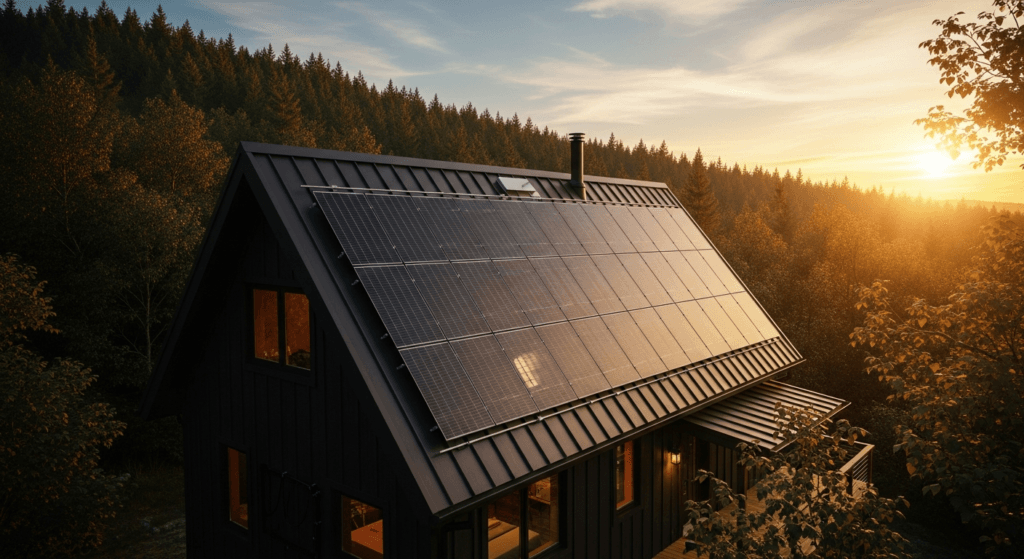
Panneau solaire 500w | Guide Technique d’Ingénierie & Installation 2026
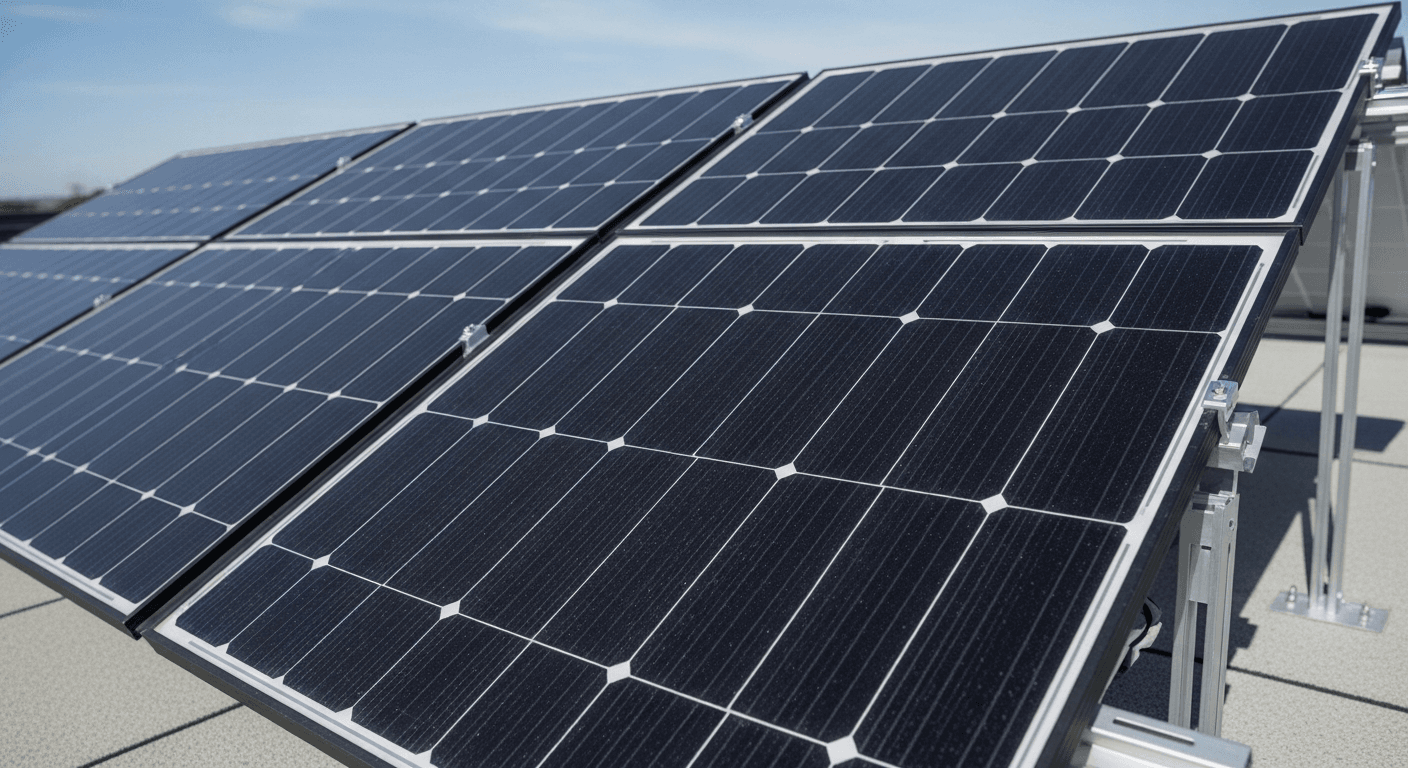
A high-capacity power storage battery is the cornerstone of any modern 500W solar panel system, representing the critical link between intermittent energy generation and consistent, on-demand power. As we navigate the 2026 energy landscape, the paradigm has decisively shifted from simple grid-tied systems to sophisticated hybrid and off-grid solutions that prioritize resilience and energy independence. The 500-watt photovoltaic (PV) module, now a mainstream standard for residential and prosumer applications, demands an equally advanced energy storage solution to harness its full potential.
This guide moves beyond surface-level discussions to provide an engineering-level analysis of integrating these high-output panels with next-generation battery systems. We will dissect the underlying physics, benchmark component efficiencies, and detail the safety protocols mandated by evolving standards. The synergy between high-wattage n-type TOPCon or HJT solar cells and the stable chemistry of Lithium Iron Phosphate (LiFePO4) batteries defines the pinnacle of personal energy generation in 2026. This is not merely about capturing sunlight; it’s about storing and deploying it with unparalleled precision and reliability.
Understanding this intricate relationship is paramount for engineers, installers, and discerning homeowners aiming to build a system that is not only powerful but also safe, durable, and future-proof. We will explore the technical specifications that separate market-leading components from the rest, ensuring your investment delivers optimal performance for decades. This is the definitive technical brief for mastering the 500W solar panel and its essential energy storage counterpart.
Deep Technical Analysis of 500W Solar Systems
A comprehensive understanding of a 500W solar installation begins with the fundamental physics of energy conversion and extends through the meticulous calculation of system loads and component sizing. By 2026, marginal gains in efficiency at each stage compound to create a significantly more productive and reliable system. We will now dissect these core technical pillars.
The Physics of Advanced Photovoltaic Conversion
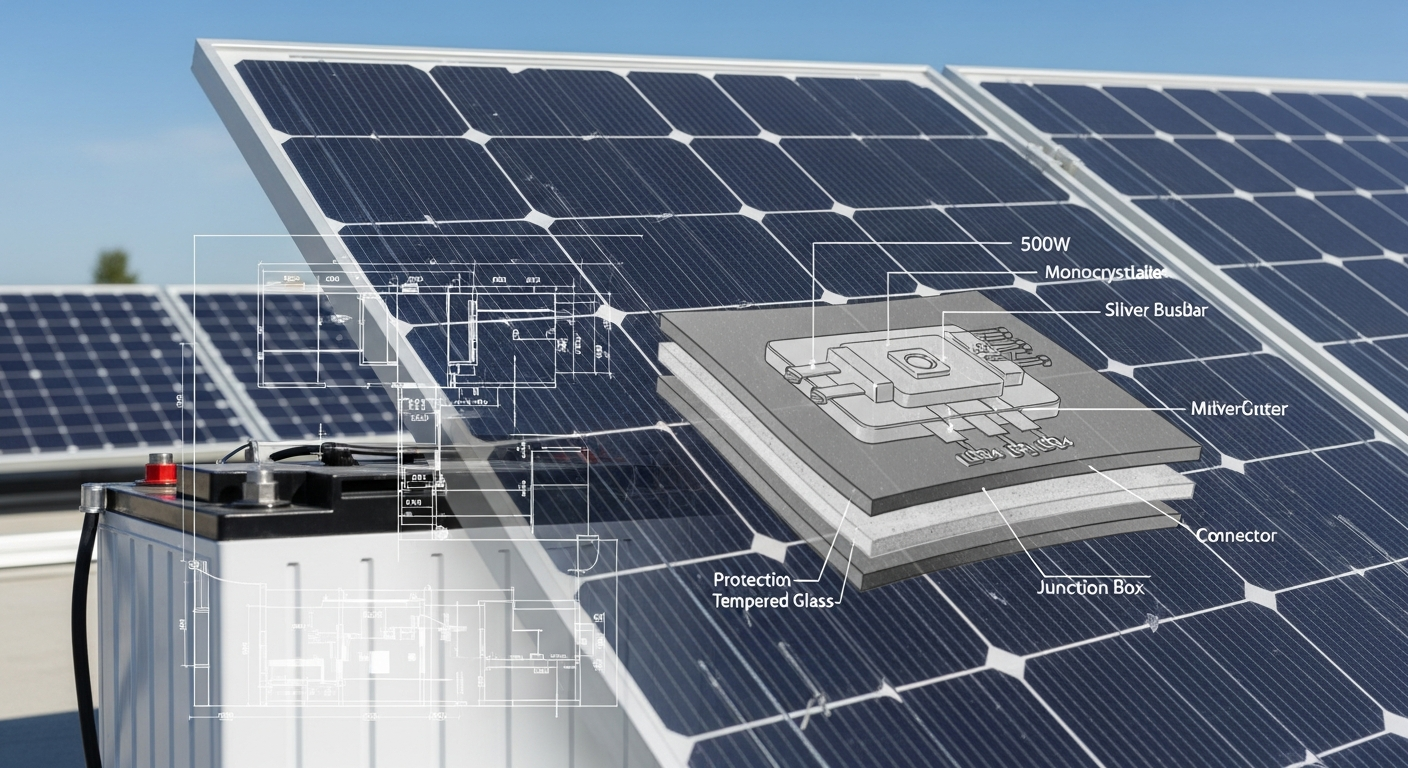
The heart of a modern 500W panel is the photovoltaic cell, which operates on the principle of the photovoltaic effect. When photons from sunlight strike the semiconductor material (typically n-type monocrystalline silicon in 2026), they transfer their energy to electrons. If the photon energy exceeds the material’s bandgap, it excites an electron, creating an electron-hole pair. The genius of the PV cell lies in its internal p-n junction, which establishes an electric field that sweeps these charge carriers apart before they can recombine.
This separation forces electrons to travel through an external circuit, generating direct current (DC). In today’s n-type TOPCon (Tunnel Oxide Passivated Contact) cells, a key innovation is an ultra-thin layer of silicon dioxide and a layer of doped polysilicon on the rear surface. This structure “passivates” the surface, drastically reducing electron-hole recombination and boosting efficiency. This is a significant improvement over the previous generation’s p-type PERC (Passivated Emitter and Rear Cell) technology, leading to higher voltage (Voc) and better temperature coefficients.
Component Efficiency Benchmarks for 2026
System efficiency is a product of the efficiencies of its individual components. A chain is only as strong as its weakest link, and in a solar system, every percentage point matters.
- Photovoltaic Panels: High-end 500W+ monocrystalline panels utilizing n-type TOPCon or Heterojunction (HJT) technology now consistently achieve module efficiencies of 23-25%. Their superior temperature coefficient (around -0.25% to -0.30% per degree Celsius) means less power degradation in real-world high-temperature conditions.
- Inverters: The DC-to-AC conversion is handled by pure sine wave inverters, which are critical for sensitive electronics. In 2026, leading hybrid inverters (combining solar inverter and battery inverter) boast peak efficiencies exceeding 97.5%. Microinverters and DC optimizers also maintain high efficiency while mitigating shading-related losses at the panel level.
- Charge Controllers: For any system with a battery, a Maximum Power Point Tracking (MPPT) charge controller is non-negotiable. These devices feature tracking efficiencies of over 99%. They constantly adjust the electrical operating point of the PV array to the “knee” of the I-V curve, ensuring maximum power extraction as irradiance and temperature fluctuate.
- Power Storage Battery: The round-trip efficiency of a LiFePO4 power storage battery is a key metric. This measures the energy retrieved versus the energy put in. For 2026-era LiFePO4 batteries, this figure is typically above 95%, a stark contrast to the 80-85% common with lead-acid batteries.
Load Calculation and System Sizing Strategies
Proper system sizing is an engineering imperative that prevents underperformance and premature component failure. The process begins with a detailed energy audit to determine the total daily energy consumption in Watt-hours (Wh).
Battery Bank Sizing: The core formula for sizing your battery bank is:
Battery Capacity (Ah) = [Daily Energy Consumption (Wh) * Days of Autonomy] / [System Voltage (V) * Depth of Discharge (DoD) * Inverter Efficiency]
For LiFePO4 batteries, a DoD of 80-90% is standard, allowing for deeper cycles without significant degradation. “Days of Autonomy” refers to the number of days the system can run on battery power alone, with 1-2 days being typical for residential backup.
PV Array Sizing: To determine the number of 500W panels needed, you must account for your location’s Peak Sun Hours (PSH), which is the average number of hours per day that solar irradiance equals 1000 W/m². The formula is:
Total PV Array Wattage = Daily Energy Consumption (Wh) / (PSH * System Derate Factor)
The System Derate Factor (typically 0.77 to 0.85) accounts for real-world losses from temperature, wiring (voltage drop), inverter inefficiency, soiling, and component degradation over time. Voltage drop, calculated as V_drop = Current (I) * Resistance (R), must be kept below 3% from the array to the charge controller by selecting the appropriate American Wire Gauge (AWG) for the cable run length.
Engineering Innovations in Power Storage Battery Technology
The evolution of the power storage battery is as crucial as the advancement in PV cells. In 2026, the focus is on safety, longevity, energy density, and intelligent system integration. The battery is no longer a passive reservoir but an active, intelligent hub of the home’s energy ecosystem.
Dominance of LiFePO4 and Emerging Chemistries
Lithium Iron Phosphate (LiFePO4) has become the undisputed champion for stationary solar storage. Its key advantage is a highly stable molecular structure that is far less prone to thermal runaway compared to energy-dense chemistries like Nickel Manganese Cobalt (NMC). This inherent safety is complemented by an exceptional cycle life, with leading manufacturers guaranteeing 6,000 to 10,000 cycles at an 80% depth of discharge. This translates to a usable lifespan of 15-20 years in a typical daily cycling application.
While LiFePO4 dominates, engineers are closely watching emerging technologies. Perovskite-on-silicon tandem cells are pushing PV efficiency limits in laboratories, promising future panels that could exceed 30% efficiency. For storage, solid-state batteries offer the potential for even greater energy density and safety, but in 2026, they remain prohibitively expensive for residential-scale applications. Sodium-ion batteries are also gaining traction as a lower-cost, resource-abundant alternative for large-scale stationary storage, though their lower energy density makes them less ideal for space-constrained home installations.
Brand-Specific Innovations and System Architecture
Leading manufacturers differentiate themselves through proprietary technology and system architecture:
- Victron Energy: Renowned for its modular and robust components, Victron excels in complex off-grid and marine applications. Their VE.Bus communication protocol allows seamless integration between their MultiPlus-II inverter/chargers, MPPT solar chargers, and Lynx Distributor systems. This creates a highly customizable and scalable ecosystem favored by professional installers.
- EcoFlow & Bluetti: These brands have revolutionized the market with their integrated, user-friendly “power station” approach. Products like the EcoFlow PowerKit and Bluetti EP900 bundle the inverter, MPPT controller, and battery into a single, plug-and-play unit. Their focus on high C-rate batteries allows for rapid charging and the ability to power high-draw appliances, appealing to the prosumer and DIY markets.
- Tesla Powerwall: The Tesla Powerwall 3 (expected by 2026) represents the pinnacle of grid-integrated AC-coupled systems. Its key innovation lies in its software, which intelligently manages charging and discharging based on time-of-use electricity rates, storm forecasts, and user preferences. Its integrated solar inverter simplifies installation for new PV systems.
Technical Comparison of 2026 Solar & Storage Kits
Choosing the right integrated system requires a detailed comparison of its core components. The following table breaks down five exemplary kits representative of the 2026 market, highlighting the engineering trade-offs between modularity, integration, and performance.
| Model / Kit | Panel Technology | Battery Chemistry | Usable Capacity (kWh) | Inverter Type / Output | Key Engineering Feature |
|---|---|---|---|---|---|
| Victron Off-Grid Pro | N-Type TOPCon (Bifacial) | LiFePO4 (LFP) | 10.2 (Scalable to 40+) | Hybrid / 5kW Pure Sine | VE.Bus protocol for ultimate modularity and control. |
| EcoFlow PowerKit Pro 15kWh | N-Type HJT | LiFePO4 (LFP) | 13.5 (at 90% DoD) | Integrated / 7.2kW Pure Sine | High C-rate for rapid charge/discharge; plug-and-play design. |
| Bluetti EP900 & B500 System | N-Type TOPCon | LiFePO4 (LFP) | 9.9 (Scalable to 19.8) | Hybrid / 9kW Pure Sine | Uninterruptible Power Supply (UPS) with <10ms switchover. |
| Tesla Powerwall 3 System | Proprietary (HJT equivalent) | LiFePO4 (LFP) | 13.5 | Integrated Hybrid / 11.5kW | Advanced software for grid service optimization (time-of-use). |
| SolarKiit Custom Pro-Build | Perovskite-Si Tandem | LiFePO4 (LFP) | Custom (15kWh example) | Modular Hybrid / 8kW Pure Sine | Component-level selection for peak efficiency and specific use-case. |
System Safety, Compliance, and Longevity
A high-power solar and storage system is an electrical power plant attached to a home. As such, adherence to safety standards and codes is not optional; it is a fundamental engineering requirement. Longevity and performance are direct results of a safety-first design philosophy.
Electrical Safety and NEC Compliance
The National Electrical Code (NEC) provides the framework for safe solar and storage installations in the United States. Key articles for 2026 include NEC Article 690 (Solar Photovoltaic Systems) and Article 706 (Energy Storage Systems). Compliance requires meticulous attention to overcurrent protection (fuses and circuit breakers), proper equipment grounding, and clear labeling of all components. A critical requirement is rapid shutdown, which allows firefighters to de-energize the solar array at the panel level, eliminating high DC voltage on the roof during an emergency.
All wiring must be housed in appropriate conduit and sized to handle maximum current while minimizing voltage drop. Connectors, such as MC4, must be from the same manufacturer to ensure a secure and safe connection, preventing potential arc faults. Professional installation is crucial to ensure every aspect of the code is met.
Ingress Protection (IP) Ratings and Environmental Hardening
Durability is dictated by how well components withstand environmental stressors. Ingress Protection (IP) ratings are critical here. Outdoor-mounted equipment, like PV junction boxes and inverter enclosures, must have a minimum rating of IP65. This certifies they are dust-tight and protected against water jets from any direction. For connectors or components in flood-prone areas, an IP67 or IP68 rating is necessary, indicating they can be temporarily or continuously submerged in water without damage.
Battery Safety, BMS, and Fire Protocols
The Battery Management System (BMS) is the brain of the power storage battery. It is an intelligent circuit board that monitors cell-level voltage, temperature, and current. A sophisticated BMS actively balances the cells during charging and discharging to maximize lifespan and prevents dangerous conditions like overcharging, over-discharging, short-circuiting, and thermal runaway. The inherent chemical stability of LiFePO4 greatly reduces fire risk, but the BMS provides the essential active protection layer.
Furthermore, all reputable energy storage systems must be certified to UL 9540, a comprehensive safety standard for Energy Storage Systems and Equipment. This certification involves rigorous testing of the entire system, including the battery, inverter, and BMS, to ensure they operate safely together. Proper physical placement, with adequate ventilation and clearance from combustible materials, is the final piece of the fire safety puzzle.
Pre-Installation Operational Checklist
A successful installation is 90% planning. Before a single tool is lifted, a thorough pre-installation process must be completed. This checklist is designed for homeowners and installers to ensure all critical variables are accounted for, preventing costly errors and maximizing system performance from day one.
- Structural Engineering Assessment: Verify the structural integrity of the roof or ground-mount location to support the total weight of the PV array and mounting hardware (typically 3-4 lbs/sq ft).
- Site Survey & Shading Analysis: Conduct a comprehensive site survey using a tool like a Solar Pathfinder or drone-based software to identify any potential shading from trees, chimneys, or future construction. Shading can disproportionately impact array output.
- Permitting and Utility Interconnection: Confirm all local building codes, homeowner association (HOA) rules, and utility interconnection requirements. Submit applications and receive all necessary approvals before beginning work.
- Detailed Load Analysis: Perform a 24-hour (or longer) energy audit of the property to establish an accurate daily Watt-hour (Wh) consumption profile. This is the foundation for all sizing calculations.
- Component Specification: Finalize the selection of all major components—panels, inverter, battery, charge controller, and mounting hardware—ensuring they are compatible and certified for use.
- Electrical System Design: Create a detailed one-line electrical diagram showing all wiring, conduit runs, disconnects, and overcurrent protection devices. Calculate wire gauges (AWG) to ensure voltage drop is under 3%.
- Safety Plan: Establish a clear safety plan covering fall protection for roof work, lockout/tagout procedures for electrical circuits, and proper handling of heavy components.
Advanced Engineering FAQ
How does the temperature coefficient of a 500W panel affect real-world energy yield?
The temperature coefficient, typically expressed as %/°C, quantifies how much power a solar panel loses for every degree Celsius its temperature rises above the Standard Test Condition (STC) of 25°C (77°F). For a 500W panel with a -0.30%/°C coefficient, a cell temperature of 65°C (common on a hot sunny day) means a 40°C rise. This results in a power loss of 40°C * 0.30%/°C = 12%. The 500W panel would only produce 440W (500W * 0.88). N-type cells have superior coefficients compared to older p-type, making them perform significantly better in hot climates.
What are the critical differences between an AC-coupled and a DC-coupled power storage battery system?
In a DC-coupled system, power flows from the DC solar panels, through a charge controller, to the DC battery, and is then inverted to AC for home use. It’s highly efficient for new installations as energy is stored with only one conversion. In an AC-coupled system (like retrofitting a Tesla Powerwall to an existing grid-tied system), DC solar power is first inverted to AC by a grid-tied inverter, then converted back to DC by the battery’s internal charger to store it, and finally inverted back to AC for use. This involves more conversions (DC-AC-DC-AC), leading to slightly lower round-trip efficiency but offering greater flexibility for existing solar arrays.
Can I oversize my solar array relative to my inverter’s rating (DC/AC ratio), and what are the benefits?
Yes, this practice, known as “inverter clipping” or designing for a high DC/AC ratio (e.g., 1.2 to 1.5), is common and often beneficial. An inverter has a maximum AC power output. By oversizing the DC solar array, the inverter will reach its peak output earlier in the day and stay there longer, producing more total energy (kWh) over the day. While some peak power (kW) is “clipped” or lost during midday on perfect sunny days, this is often outweighed by the increased production during morning, evening, and overcast conditions. This broadens the power production curve, maximizing energy harvest.
Explain the role of the Battery Management System (BMS) beyond simple overcharge protection.
A modern BMS is a sophisticated computer. Beyond basic voltage and current protection, it performs critical functions like cell balancing, where it ensures all individual cells within a battery pack are at an equal state of charge, preventing weaker cells from being over-stressed. It also manages thermal regulation by monitoring multiple temperature sensors and can trigger cooling systems or reduce charge/discharge rates. Furthermore, it calculates and reports the State of Charge (SoC) and State of Health (SoH), providing crucial data for system performance and longevity diagnostics.
What is Maximum Power Point Tracking (MPPT) and why is it superior to PWM for 500W panels?
Maximum Power Point Tracking (MPPT) is an electronic DC-to-DC converter technology. A solar panel’s voltage and current output vary continuously with sunlight and temperature. The MPPT controller constantly sweeps the panel’s I-V curve to find the “maximum power point” (Vmp, Imp) where the product of voltage and current is highest. It then converts this to the optimal voltage for charging the battery. A PWM (Pulse Width Modulation) controller simply pulls the panel’s voltage down to the battery’s voltage, operating it off its maximum power point and wasting significant energy. For high-voltage 500W panels, using a PWM controller can waste up to 30% of the available power, making MPPT an absolute necessity.
In conclusion, the integration of a 500W solar panel with an advanced battery system in 2026 is a feat of applied engineering that balances power generation, storage efficiency, and robust safety protocols. The technical superiority of n-type PV cells and the safety and longevity of LiFePO4 chemistry have created a new benchmark for residential energy independence. Success, however, is not found in individual components but in their synergistic design and meticulous installation. Ultimately, the right power storage battery transforms a simple solar installation into a resilient and intelligent energy hub for the future.
📥 Associated Resource:

El Kouriani Abde Civil Engineer & Founder of SolarKiit
El Kouriani Abde is a seasoned Civil Engineer and Project Manager with over 21 years of field experience. As the founder and publisher of SolarKiit.com, he leverages his deep technical background to simplify complex renewable energy concepts. His mission is to provide homeowners and professionals with accurate, engineering-grade guides to maximize their solar investments and achieve energy independence.