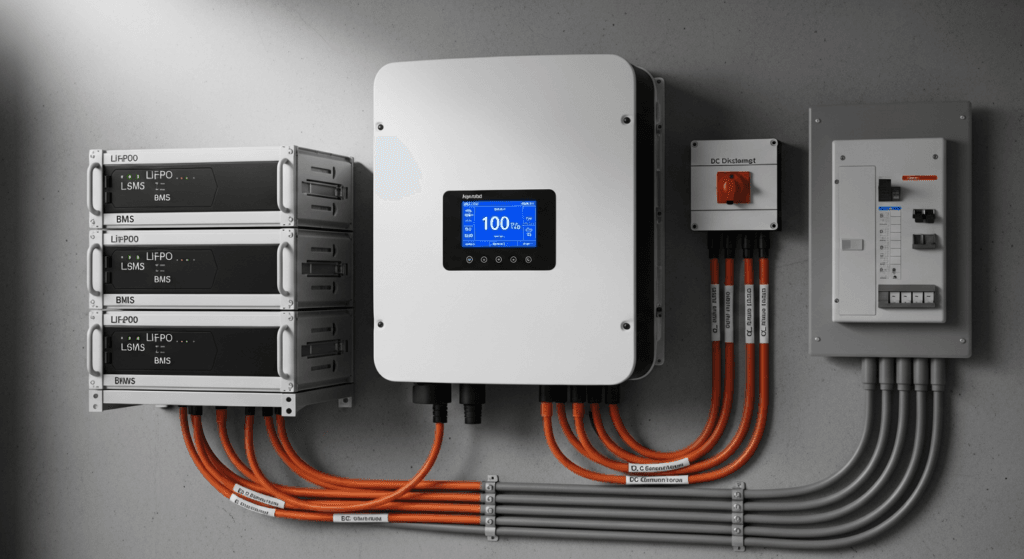
Solar Inverter Efficiency: The Ultimate Guide to Maximizing Your PV System’s Output & ROI
In the rapidly evolving solar landscape of 2026, the conversation has decisively shifted. We’ve moved beyond simply adopting solar to meticulously optimizing it for maximum financial return and energy independence. The solar inverter, once a humble backstage component, now stands center stage as the critical brain of the entire photovoltaic (PV) system. Its efficiency is no longer a footnote on a spec sheet; it is the primary determinant of your system’s lifetime energy harvest and, consequently, your return on investment (ROI).
As utility grids face increasing strain and energy costs continue their upward trajectory, the role of the inverter has expanded. Modern inverters are sophisticated power management hubs, orchestrating the flow of energy between your solar panels, battery storage, electric vehicle (EV), and the grid. A seemingly minor 1-2% difference in efficiency can translate to thousands of lost kilowatt-hours—and dollars—over the 25-year lifespan of a PV system.
This guide moves past generic advice to provide a deep, engineering-level analysis of inverter efficiency. We will dissect the physics of power conversion, establish the critical performance benchmarks for 2026, and explore the cutting-edge technologies from industry leaders. Understanding these principles is paramount for homeowners and system designers aiming to build a resilient, high-performance solar asset, not just a collection of panels on a roof.
Deep Technical Analysis: The Engineering Behind Peak Performance
At its core, a solar inverter’s function is to perform a fundamental energy transformation. Your solar panels generate Direct Current (DC), a unidirectional flow of electricity. However, the appliances in your home and the utility grid operate on Alternating Current (AC), where the current rapidly reverses direction. The inverter’s job is to execute this DC-to-AC conversion with minimal energy loss.
This conversion is not a simple process. It involves high-frequency switching of solid-state components, typically Insulated-Gate Bipolar Transistors (IGBTs) or, in more advanced 2026 models, Silicon Carbide (SiC) or Gallium Nitride (GaN) semiconductors. These newer materials offer lower resistance and faster switching speeds, significantly reducing the thermal energy (heat) lost during conversion. This is a primary source of efficiency gains in modern hardware.
The Physics of Conversion: Pure Sine Wave vs. The Alternatives
The quality of the AC output is as important as the efficiency of the conversion itself. The gold standard is the Pure Sine Wave, a smooth, clean waveform that perfectly replicates or even exceeds the quality of utility-provided power. This is non-negotiable for modern homes filled with sensitive electronics, microprocessors, and variable-speed motors found in high-efficiency appliances.
Lesser, outdated inverters produce a Modified Sine Wave, a blocky, stepped approximation of a true sine wave. This “dirty power” can cause buzzing in audio equipment, premature failure in electronics, and operational issues with devices like refrigerators and medical equipment. For any serious solar installation in 2026, a Pure Sine Wave inverter is the only viable choice.
Efficiency Benchmarks: Beyond the Peak Number
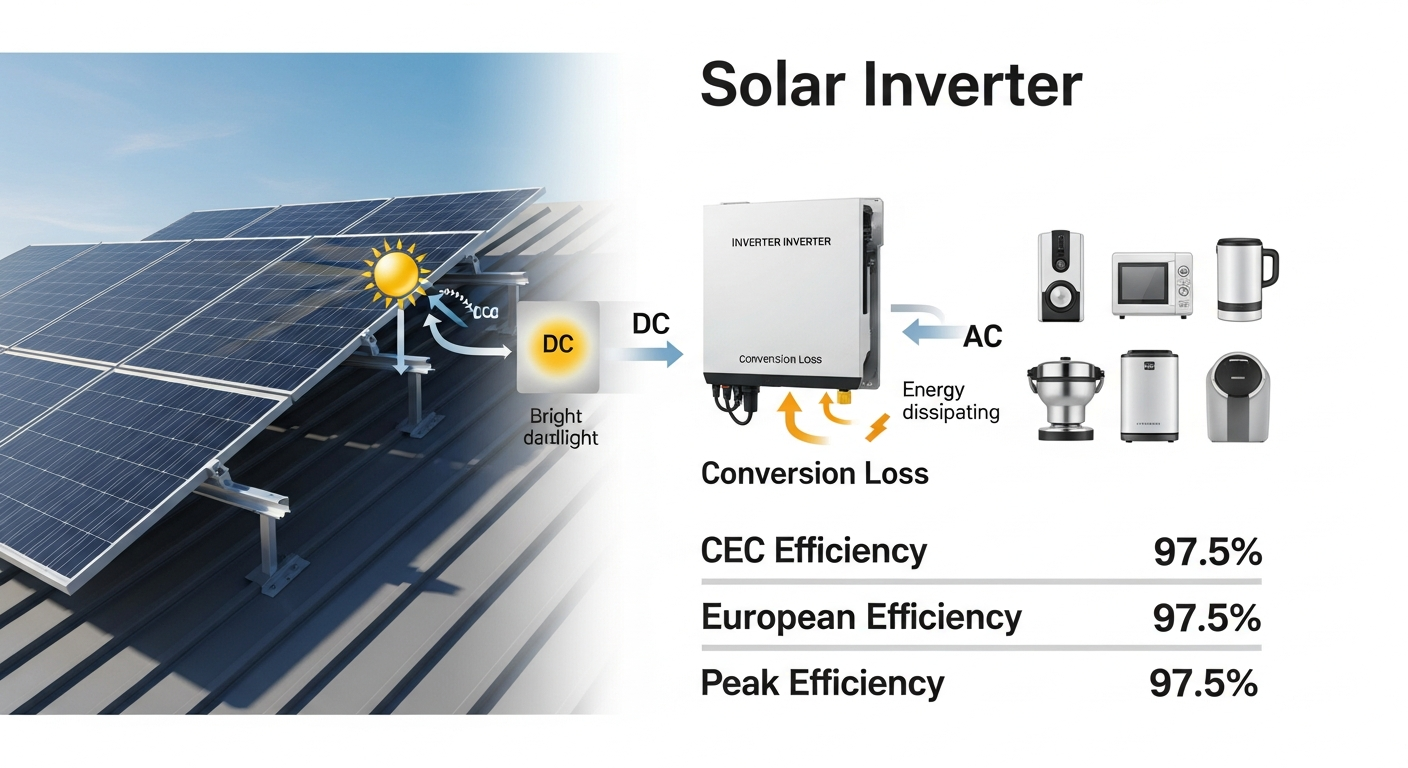
Manufacturers often advertise “peak efficiency,” a figure typically reaching 98-99%. While impressive, this metric only reflects the inverter’s performance under ideal laboratory conditions—a specific DC voltage and power load that may only occur for a few minutes on a perfect day. A far more crucial metric is the CEC (California Energy Commission) Weighted Efficiency or its European equivalent.
CEC weighted efficiency calculates a performance average across a range of power levels (10%, 20%, 30%, 50%, 75%, and 100% of the inverter’s rated power). This provides a much more realistic picture of how the inverter will perform throughout an actual solar day, with its varying levels of sunlight and cloud cover. For 2026, you should demand a CEC weighted efficiency of at least 97.5% for premium string inverters and 96.5% for microinverters and power optimizers.
Load Calculation and Strategic Sizing
Properly sizing an inverter to your PV array is a critical engineering task. Undersizing the inverter means you will experience “clipping,” where the inverter cannot process all the DC power generated by your panels during peak sun hours, wasting potential energy. Grossly oversizing the inverter means it will spend much of its time operating at a low power level, where its efficiency is typically much lower.
The optimal strategy is often to slightly “oversize” the DC array relative to the inverter’s AC rating. A common DC-to-AC ratio is 1.2 to 1.4 (e.g., a 12 kW DC array paired with a 10 kW AC inverter). This allows the inverter to reach its most efficient operating range earlier in the morning and stay there later in the afternoon, producing a broader, fatter production curve. While it may “clip” some power at solar noon, the total daily energy harvest (kWh) is significantly increased, maximizing ROI.
Engineering Specifications & Innovations in 2026
The competitive landscape has spurred incredible innovation, with manufacturers differentiating through integrated ecosystems, advanced materials, and software intelligence. The focus is on holistic energy management, not just power conversion.
Leading brands like Victron Energy continue to dominate the off-grid and hybrid markets. Their MultiPlus-II and Quattro inverter/chargers are renowned for their rugged build quality and unparalleled system flexibility. Victron’s VRM (Victron Remote Management) portal provides granular, component-level data, allowing engineers to remotely diagnose and optimize complex systems involving multiple power sources like solar, battery, and generators.
In the residential grid-tie and storage sector, Tesla has redefined the market with its Powerwall ecosystem. The Tesla Powerwall 3 integrates a powerful 11.5 kW solar inverter directly into the battery unit. This DC-coupled design minimizes conversion losses when charging the battery directly from solar. Its true strength lies in its software, which uses predictive algorithms for storm-watch preparation and time-of-use arbitrage to maximize savings.
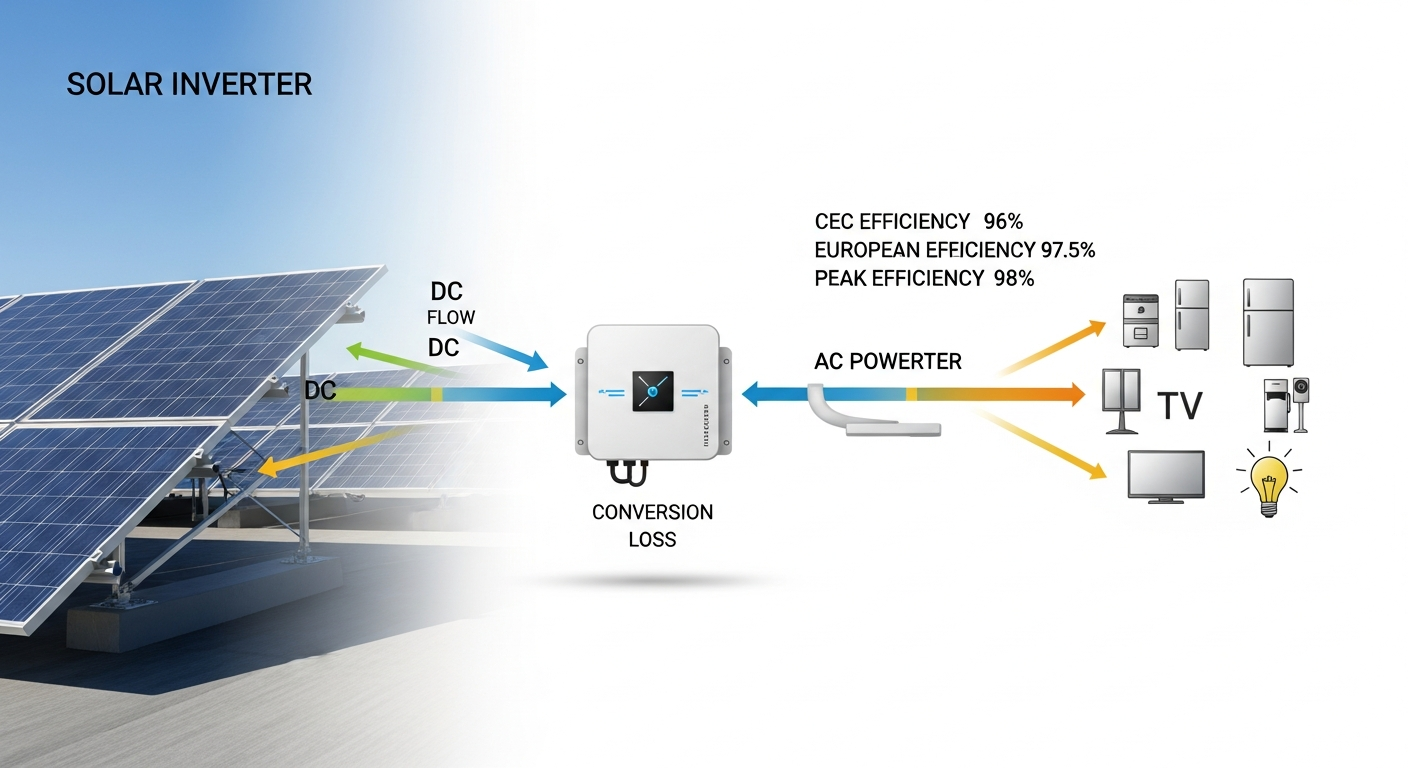
Modular and portable power solutions from companies like EcoFlow and Bluetti are now scaling up to whole-home backup. The EcoFlow DELTA Pro Ultra, for instance, pairs a 7.2 kW inverter with stackable LiFePO4 battery packs. These systems leverage high-frequency conversion and Gallium Nitride (GaN) components to achieve high power density in a compact form factor, bridging the gap between portable power and permanent home integration.
Underpinning these advancements is the development of new PV cell materials. The emergence of Perovskite-on-Silicon tandem cells, pushing panel efficiencies towards and beyond 30%, places new demands on inverters. These panels operate at different voltages, requiring inverters with wider and more dynamic Maximum Power Point Tracking (MPPT) voltage ranges to extract every possible watt of energy.
Technical Comparison of Leading 2026 Inverter Solutions
Choosing the right inverter requires a detailed comparison of technical specifications. The table below contrasts five leading models representative of the 2026 market, highlighting the key metrics that drive performance and application suitability.
| Model | Type | Peak Efficiency | CEC Weighted Efficiency | Max Continuous Output | MPPT Voltage Range | Key Feature |
|---|---|---|---|---|---|---|
| Enphase IQ9M | Microinverter | 97.8% | 97.2% | 380 VA | 25-58 V | Module-level monitoring & rapid shutdown |
| SolarEdge SE11400H-US | String Inverter w/ Optimizers | 99.2% | 98.0% | 11.4 kW | Fixed 480 Vdc (Optimizer-based) | DC-level optimization for shade |
| Tesla Powerwall 3 | Integrated Battery/Inverter | 97.5% (PV to AC) | 96.5% | 11.5 kW | 60-550 V | Seamless grid/solar/battery integration |
| Victron Quattro-II 48/5000 | Hybrid Inverter/Charger | 96% | N/A (Off-grid focus) | 4.0 kW | Paired with external MPPT controller | Dual AC inputs for grid/generator flexibility |
| EcoFlow DELTA Pro Ultra | Modular Inverter + Battery | 97% | 96.0% | 7.2 kW | 30-150 V (per MPPT input) | Scalable battery capacity (6-90 kWh) |
Safety, Standards, and System Longevity
A high-performance inverter is also a safe one. Adherence to electrical codes and safety standards is non-negotiable and ensures the protection of your property and any personnel working on the system. The primary governing document in the United States is the National Electrical Code (NEC), particularly Article 690, which covers solar PV systems.
A critical safety mandate is NEC 690.12: Rapid Shutdown. This requires a method to de-energize the DC conductors on the roof to a safe voltage level (typically under 80V) within 30 seconds. This is crucial for firefighter safety, allowing them to work on the roof without the risk of electrocution from live DC wiring. Module-Level Power Electronics (MLPE) like microinverters and power optimizers have this functionality built-in.
Environmental protection is quantified by the Ingress Protection (IP) rating. An inverter rated at IP65 is dust-tight and protected against low-pressure water jets, making it suitable for most outdoor installations. A higher rating like IP67 means the unit can withstand temporary immersion in water, offering maximum durability in harsh climates. Always match the IP rating to the installation environment.
Furthermore, modern inverters must include integrated safety features like Arc-Fault Circuit Interruption (AFCI), which detects and mitigates dangerous electrical arcs that can cause fires, and Ground-Fault Detector Interrupters (GFDI). Proper thermal management, including robust heat sinks and, in some cases, active cooling fans, is essential to prevent overheating, which degrades components and reduces both efficiency and lifespan.
Operational Pre-Installation Checklist
A successful installation begins with meticulous planning. Before a single tool is unboxed, a thorough pre-installation audit is essential to ensure safety, performance, and code compliance. Use this checklist as a guide for your project planning.
- Site & Structural Assessment: Verify the roof’s structural integrity and its ability to support the weight of the PV array and mounting hardware.
- Load Analysis: Complete a detailed energy audit of the property to determine average daily consumption (kWh) and peak power demand (kW). This is critical for correct inverter and battery sizing.
- PV Array Design & Shading Analysis: Map out panel placement, accounting for PV orientation and tilt. Use a solar pathfinder or software to identify any potential shading from trees or structures that would impact performance.
- Component Matching: Confirm that the PV array’s open-circuit voltage (Voc) and short-circuit current (Isc) are within the inverter’s specified MPPT and maximum input limits under all temperature conditions.
- Voltage Drop Calculation: Plan all DC and AC cable runs. Calculate the voltage drop for the longest runs to ensure it remains below 2-3% to prevent significant power loss. Use appropriately gauged wire.
- Code & Utility Compliance: Review all local building codes, NEC requirements (especially for rapid shutdown), and the local utility’s interconnection agreement process and technical requirements.
- Safety Plan: Establish a clear safety plan for the installation crew, including fall protection, lockout/tagout procedures, and proper handling of high-voltage DC equipment.
Advanced Inverter Efficiency FAQ
What is the real-world financial impact of a 1% difference in CEC weighted efficiency?
For a 10 kW PV system that generates approximately 14,000 kWh per year, a 1% difference in efficiency (e.g., 97% vs. 96%) equates to 140 kWh of lost energy annually. At an average 2026 electricity price of $0.25/kWh, that’s a loss of $35 per year. Over the 25-year life of the system, this single percentage point amounts to a $875 loss, not accounting for future electricity price inflation.
How can inverter “clipping” actually improve my system’s ROI?
Clipping occurs when the DC power from the panels exceeds the inverter’s maximum AC output. While it seems like wasted energy, intentionally designing for some clipping by oversizing the DC array (e.g., a 1.25 DC/AC ratio) is a smart strategy. It allows the inverter to operate at its peak efficiency for a much longer portion of the day, significantly boosting energy harvest during the morning and afternoon “shoulders,” more than compensating for the small amount of power clipped at solar noon.
Why is a Pure Sine Wave inverter absolutely critical for a modern home?
Modern homes are filled with devices that rely on microprocessors and sensitive power supplies: computers, LED lighting, smart appliances, and variable-speed motors in HVAC systems. A Modified Sine Wave’s blocky waveform can introduce harmonic distortion, causing these devices to run hotter, less efficiently, and fail prematurely. A Pure Sine Wave provides clean, stable power, ensuring the longevity and proper function of all your electronics.
What is the role of MPPT in maximizing inverter efficiency?
MPPT stands for Maximum Power Point Tracking. It is a sophisticated algorithm and electronic circuit within the inverter that constantly adjusts the electrical load on the solar array. A solar panel’s power output varies with its voltage and current. The MPPT’s job is to find the “sweet spot”—the exact voltage and current combination that yields the maximum possible power (watts) at any given moment of sunlight, temperature, and shading. An effective MPPT can boost energy harvest by up to 30% compared to non-MPPT systems.
Can I use a single string inverter if my panels are on different roof faces?
It is highly discouraged. A standard string inverter treats all panels in a series “string” as a single unit. If one panel is shaded or on a different orientation, its reduced output will drag down the performance of the entire string to its level. For installations with multiple orientations or shading issues, Module-Level Power Electronics (MLPE) like microinverters (one per panel) or DC power optimizers are the superior engineering solution, as they allow each panel to produce power independently.
📥 Associated Resource:

El Kouriani Abde Civil Engineer & Founder of SolarKiit
El Kouriani Abde is a seasoned Civil Engineer and Project Manager with over 21 years of field experience. As the founder and publisher of SolarKiit.com, he leverages his deep technical background to simplify complex renewable energy concepts. His mission is to provide homeowners and professionals with accurate, engineering-grade guides to maximize their solar investments and achieve energy independence.